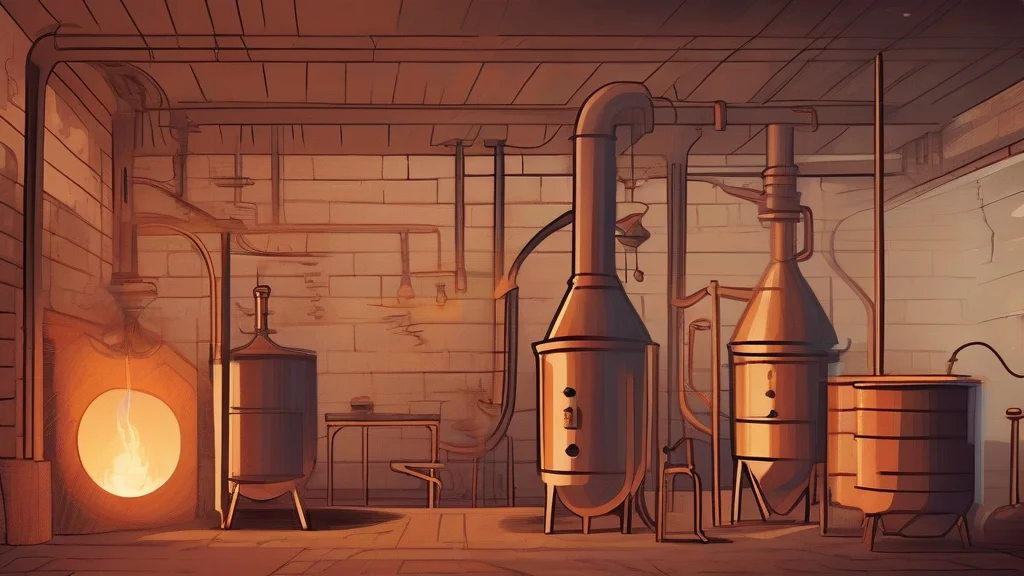
What does distilling mean?
Distilling is the process of separating or concentrating substances by heating a liquid until it vaporises and then cooling that vapour back into liquid form. It is the technique behind spirits such as whisky, gin, vodka, and rum, as well as industrial applications including the purification of water, alcohol, and essential oils. Beyond chemistry and craft production, distilling is widely used figuratively to describe the act of reducing complex information, arguments, or experiences to their clearest and most essential elements — one might speak of distilling a report into three bullet points or distilling years of research into a single insight. This figurative sense carries a positive connotation, suggesting precision, clarity, and intellectual rigour. In British spelling the related verb is usually 'distil' with a single 'l', while American usage prefers 'distill'; both forms double the consonant before '-ing'.
The process or practice of purifying or concentrating a liquid by evaporation and subsequent condensation.
"Traditional pot stills remain central to the distilling of fine malt whiskies."
Often used attributively, as in 'a distilling company'.
Present participle of distil: performing the act of purifying a liquid by heating and condensing, or figuratively extracting the essence of something.
"They are distilling a batch of botanical gin this week."
Every drop of Scotch, gin, and vodka owes its existence to the same trick ancient alchemists perfected: turning liquid to vapour and back again.
Reviewed by Deb Chak, Editor. AI-assisted content curated by RJS Tech Solutions LLP.
Etymology of distilling
The word traces back to Latin 'destillare', meaning 'to drip down', formed from 'de-' ('down') plus 'stillare' ('to drip'), itself derived from 'stilla', a drop. It passed through Old French 'distiller' before entering Middle English around the late fourteenth century. Cognates include French 'distiller' and Italian 'distillare', all preserving the original image of liquid falling drop by drop.
Related word forms
How distilling is actually used
British English typically spells the base verb 'distil', while American English uses 'distill'; both double the 'l' in '-ing'. As a gerund, it functions as a noun ('Distilling requires patience'). The literal sense is neutral in register, while the figurative sense often carries an admiring connotation of clarity and intellectual discipline.
Easily confused with distilling
Disillusioning means freeing someone from false beliefs, whereas distilling refers to purifying liquids or extracting essentials.