What does donkey mean?
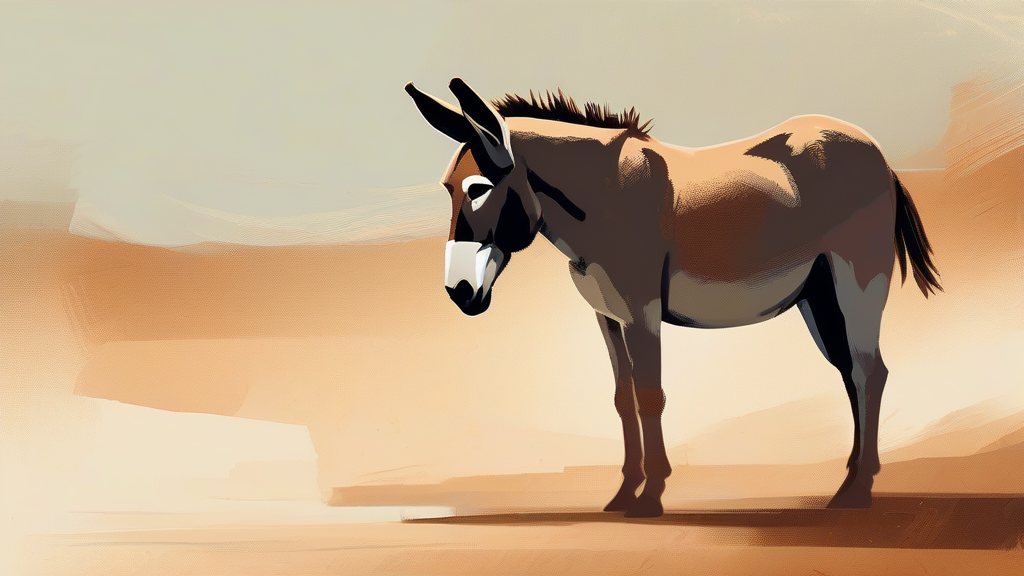
A donkey is a domesticated member of the horse family, Equus asinus, easily recognised by its long ears, short mane, grey-brown coat, and loud braying call. Bred from the African wild ass thousands of years ago, donkeys have served humanity chiefly as hardworking beasts of burden, valued for their strength, endurance, and sure-footedness on rough terrain. The word itself is surprisingly young: it emerged in English only in the late eighteenth century, probably built on 'dun', meaning dull grey-brown, as a polite substitute for the older term 'ass'. Beyond its literal sense, 'donkey' carries informal figurative uses: calling someone a donkey means they are foolish or obstinate, while phrases like 'donkey work' denote tedious labour and 'donkey's years' means a very long time. Familiar, affectionate, and deeply woven into rural life worldwide, it remains one of the most recognisable animal names in English.
A domesticated hoofed mammal of the horse family (Equus asinus) with long ears and a braying call, kept especially as a beast of burden.
"The donkey carried firewood down from the village each morning."
Preferred over 'ass' in everyday speech; in the southwestern United States, 'burro' often denotes a small or feral donkey.
Informal: a stupid, foolish, or stubborn person.
""You donkey — you've put salt in the tea instead of sugar!""
Mildly insulting but usually playful rather than harsh.
British informal: a small auxiliary engine or machine, as in 'donkey engine' or 'donkey pump'.
"The ship's donkey boiler supplied steam while the main engines were shut down."
Regular plural: add -s. Spelled 'donkeys', never 'donkies'.
"A line of donkeys trudged up the switchback trail, each laden with supplies."
The word 'donkey' didn't exist before the late 1700s — it was likely coined from 'dun' (the animal's dull grey-brown colour) simply because people wanted a politer way to say 'ass'.
Reviewed by Deb Chak, Editor. AI-assisted content curated by RJS Tech Solutions LLP.
Etymology of donkey
Despite the animal's ancient history, 'donkey' is a remarkably recent word, first recorded in English in the late eighteenth century (around 1784). Its origin is uncertain, but the leading theory derives it from 'dun', meaning a dull grey-brown colour typical of the animal, combined with a diminutive suffix such as '-key' or '-ie'. It appears to have been coined precisely because speakers wanted an alternative to 'ass', which was beginning to acquire its modern vulgar slang sense.
Related word forms
How donkey is actually used
'Donkey' is neutral in register and preferred over 'ass' in most everyday contexts because 'ass' can read as vulgar slang in American English. The figurative sense meaning a foolish person is mildly insulting but often jocular. In American English, 'burro' typically refers to small wild or feral donkeys of the Southwest.
Easily confused with donkey
A donkey is a domesticated member of the horse family, while a monkey is a primate; the two words also rhyme and are sometimes confused in spelling.
'Ass' is the older, formal name for the same animal, whereas 'donkey' arose later as a euphemistic alternative that avoids 'ass' now reading as vulgar slang.