What does doodlebug mean?
Doodlebug is an affectionate, informal English word with three distinct meanings. Most commonly it refers to the larva of the antlion, a curious insect that excavates steep, funnel-shaped pits in dry sandy soil and waits at the bottom for ants and other prey to slide down into its jaws. The word also entered history during World War II, when Londoners nicknamed the German V-1 flying bomb — with its distinctive sputtering engine and sudden silence before impact — the 'doodlebug.' In parts of the United States, particularly the South and Midwest, a doodlebug is a person who searches for underground water, oil, or lost objects using a divining rod, a folk practice known as doodlebugging. Across all senses the word carries a rustic, colloquial charm, blending childlike curiosity about nature with vivid moments of social and military history.
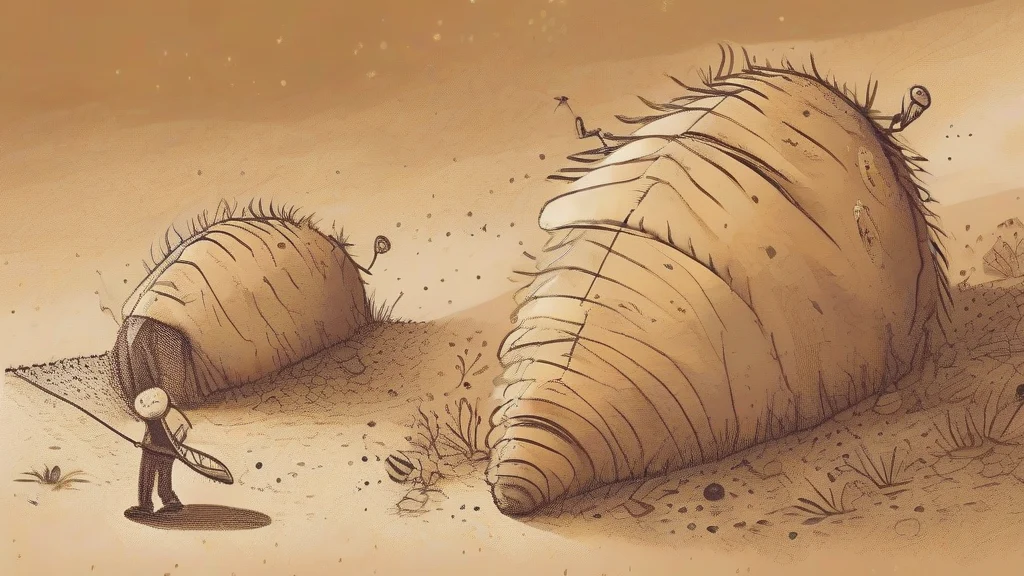
The larva of an antlion, which digs a conical pit in loose sand to trap ants and other small insects.
"A doodlebug lay half-buried at the bottom of its sandy funnel, waiting for its next meal."
Especially common in rural and children's speech in the United States and Australia.
(Informal, historical) A German V-1 flying bomb of World War II.
"When the doodlebug's engine cut out, everyone nearby braced for the explosion."
Chiefly British; now largely confined to historical accounts of the war.
(US, regional) A person who uses a divining rod to locate underground water, oil, or minerals.
"The old-timers swore the local doodlebug could find water anywhere on the farm."
Standard regular plural; applies to all senses of the noun.
"After the rain, the kids searched the riverbank for fresh doodlebugs."
The same folksy word has named a sand-trapping insect larva, Hitler's terrifying V-1 'buzz bomb,' and American oil-field diviners hunting buried treasure with a forked stick.
Reviewed by Deb Chak, Editor. AI-assisted content curated by RJS Tech Solutions LLP.
Etymology of doodlebug
Doodlebug is formed from 'doodle' plus 'bug', with 'doodle' being an old word for a foolish or simple fellow — the same root seen in the song 'Yankee Doodle'. The term arose in North America in the nineteenth century as a playful name for the antlion larva, whose erratic, scribbling tracks in the sand may have suggested idle doodling. During World War II, Britons transferred the word to the German V-1 flying bomb, whose noisy approach and abrupt silence made it memorable. The American folk sense for a divining rod user developed separately from the same whimsical impulse to attach a silly-sounding name to mysterious practices.
How doodlebug is actually used
Informal and folksy in register across all its senses. The insect sense is common in American and Australian English, especially among children and in rural speech; the flying-bomb sense is now almost entirely historical, tied to wartime Britain; the divining-rod sense survives regionally in the United States, particularly in areas where groundwater prospecting remains a folk practice.
Easily confused with doodlebug
An antlion is the adult or the species as a whole, while 'doodlebug' most often refers specifically to its predatory larval stage.
A doodle is an absent-minded scribble or drawing, whereas a doodlebug is an insect larva, a flying bomb, or a diviner — the words share only their first element.