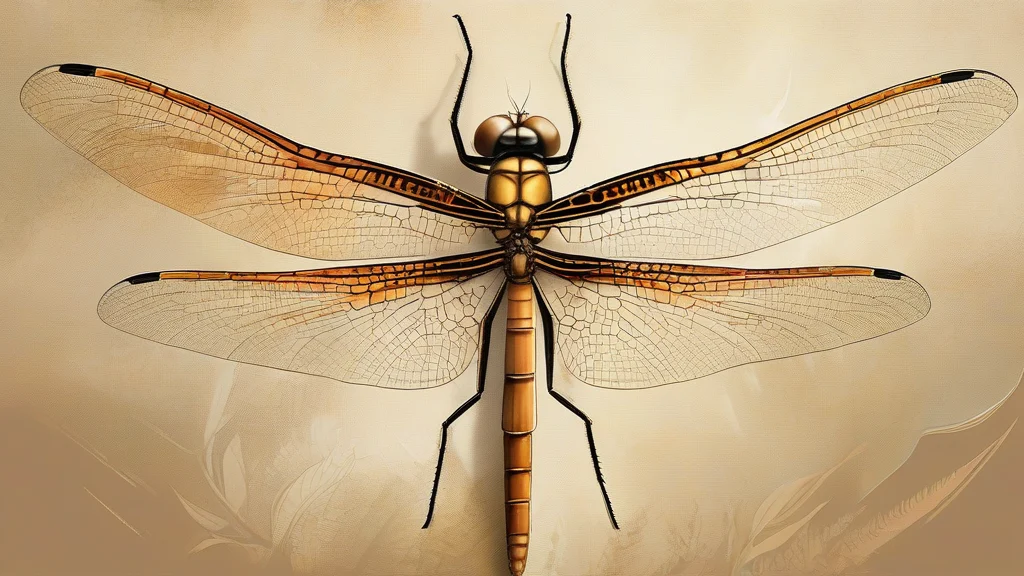
What does dragonfly mean?
A dragonfly is a swift-flying predatory insect belonging to the order Odonata and the suborder Anisoptera, recognized by its long, slender body, two pairs of powerful transparent wings that can move independently, and remarkably large compound eyes that give it nearly 360-degree vision. Dragonflies are almost always found near water — ponds, lakes, rivers, and marshes — where they hunt smaller insects such as mosquitoes and midges in mid-air, making them welcome guests in gardens. The word is used as a common noun in all registers of English, and it also appears figuratively to suggest agility, iridescence, or fleeting beauty. Dragonflies undergo incomplete metamorphosis, passing through an aquatic nymph stage before emerging as winged adults, a life cycle that has long fascinated naturalists. Because they are ancient, striking, and ecologically important as both predators and indicators of water quality, dragonflies hold an enduring place in folklore, art, and scientific study alike.
nounA fast-flying predatory insect of the order Odonata, suborder Anisoptera, having a long slender body, two pairs of strong transparent wings, and very large eyes; it is typically found near water.
- A large predatory insect of the order Odonata with two pairs of transparent wings, a long slender body, and large compound eyes, commonly found near ponds, lakes, and streams.
"A dragonfly hovered over the pond, its wings catching the afternoon light."
"A brilliant blue dragonfly skimmed across the surface of the lake."
"As a child she spent whole afternoons watching dragonflies dart among the reeds."
Regular plural: change y to i and add -es.
"Dozens of dragonflies gathered above the marsh at sunset."
Dragonflies have been around for over 300 million years — prehistoric relatives had wingspans wider than a hawk's.
Reviewed by Deb Chak, Editor. AI-assisted content curated by RJS Tech Solutions LLP.
Etymology of dragonfly
The word dragonfly first appeared in English in the early 17th century, combining 'dragon' — from Latin 'draco', meaning a serpent or mythical fire-breathing beast — with 'fly', from Old English 'flēoge'. The name likely reflects the fierce appearance or voracious hunting of the insect, and folk traditions in parts of England gave it darker names such as 'devil's darning needle'. Its root connects it to words like 'draconian' and 'dragoon', all tracing back through Latin and Greek to the idea of a great serpent or dragon.
Related word forms
How dragonfly is actually used
Dragonfly is a neutral, standard term in both formal and informal registers; the plural is regular (dragonflies). It is sometimes used figuratively to evoke lightness, speed, or fleeting beauty.
Easily confused with dragonfly
A damselfly is a related but distinct insect that holds its wings folded along its body at rest and has a slimmer build, whereas a dragonfly holds its wings outstretched horizontally.