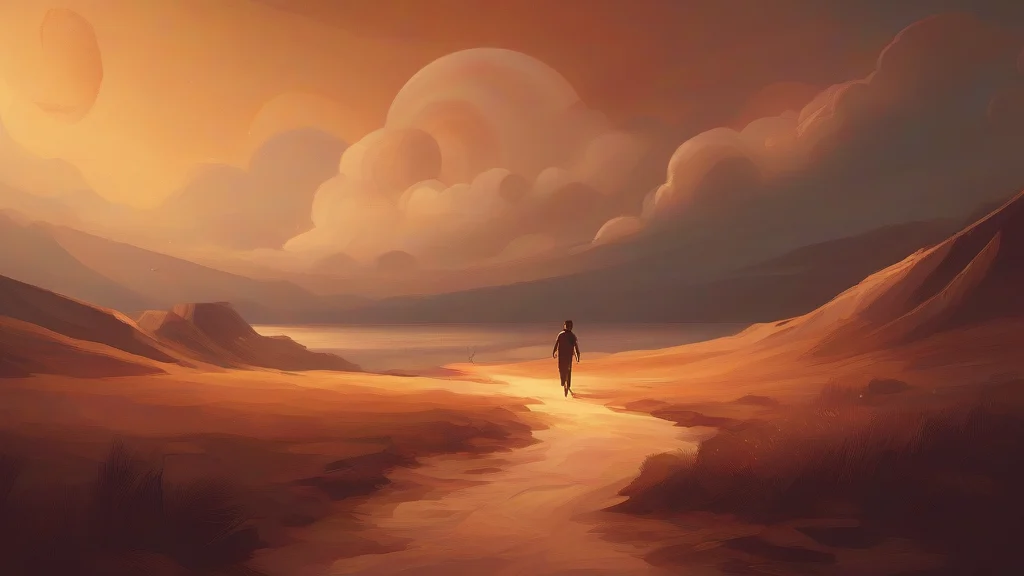
What does dreamscape mean?
A dreamscape is a dreamlike, often surreal scene or environment — either the shifting world of an actual dream or a consciously crafted imitation of one in art, film, literature, or music. The word blends 'dream' with '-scape,' on the model of 'landscape' and later formations like 'seascape' and 'soundscape,' and it emerged in the twentieth century as artists and critics sought a name for imagined spaces that feel like dreams. It typically appears in descriptive and critical writing: a painter's canvases might be called a dreamscape of floating forms, or an ambient album described as a hazy dreamscape of sound. Because it evokes wonder, strangeness, and fluidity rather than realism, the word carries an imaginative, often beautiful connotation. It is a useful term whenever ordinary language fails to capture scenes that obey the logic of sleep instead of the physical world.
A dreamlike, surreal, or fantastical scene or environment, either experienced in a dream or deliberately created in artistic work such as painting, film, literature, or music.
"The choreography unfolds across a dreamscape of mist, mirrors, and slow-moving light."
Most frequent in art, film, and music criticism; slightly literary in tone but fully standard.
A dream regarded as a mental landscape of shifting images and experiences.
"In his memoir he wanders through the dreamscape of his childhood nights, revisiting faces long forgotten."
Regular plural; used when referring to multiple dreamlike scenes or to the imagined worlds of different works or individuals.
"The gallery's three rooms hold the dreamscapes of three different painters."
A modern coinage built on 'landscape,' dreamscape swaps soil and sky for pure imagination — no two people ever visit the same one.
Reviewed by Deb Chak, Editor. AI-assisted content curated by RJS Tech Solutions LLP.
Etymology of dreamscape
Dreamscape is a twentieth-century English formation combining 'dream' (from Old English 'drēam') with the productive suffix '-scape,' borrowed by analogy with 'landscape.' That suffix ultimately traces back through Dutch 'landschap' to a Germanic root meaning a tract or expanse of land. Once 'landscape' entered English in the seventeenth century, '-scape' became a living pattern for coining words about kinds of scenery, giving rise to 'seascape,' 'cloudscape,' 'cityscape,' and eventually 'dreamscape' for scenery of the imagination.
How dreamscape is actually used
Register is neutral to slightly literary; the word is especially at home in criticism of art, film, and ambient music. It carries a positive or evocative connotation rather than a clinical one — for the psychological study of dreams, more technical terms are preferred.
Easily confused with dreamscape
A landscape is a real view of land scenery, while a dreamscape is an imagined, dreamlike scene that need not resemble any actual place.