
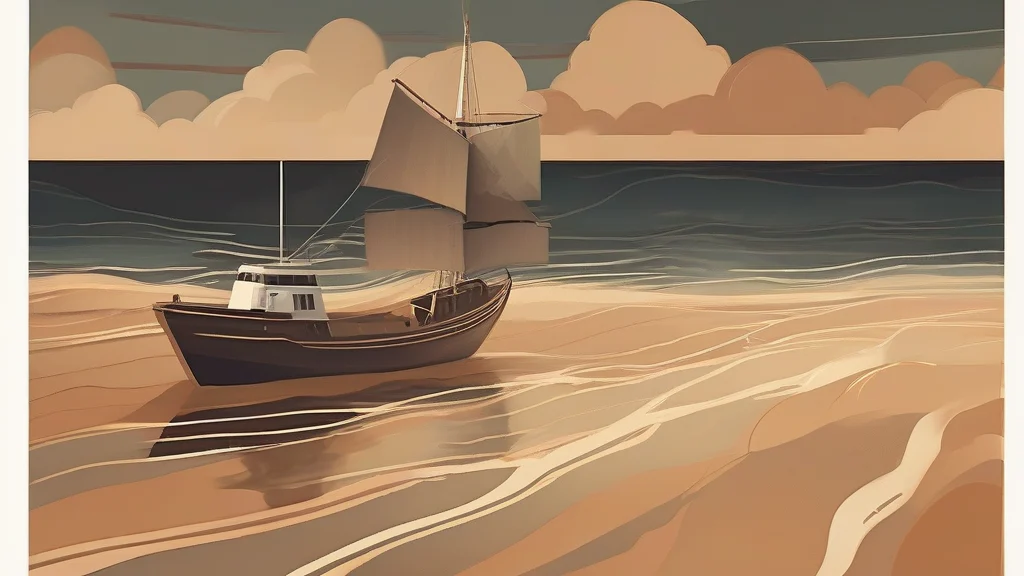
What does driftage mean?
Driftage is a noun referring to the sideways displacement of a ship or other floating object as it moves through water under the influence of currents, wind, or tide. In practical terms, it describes how far a vessel is pushed off its intended track while under way — a quantity that mariners traditionally estimated and compensated for when plotting a course. The word can also denote material that has drifted and accumulated somewhere, such as debris left along a riverbank after a flood. Largely confined to nautical and technical registers, driftage carries an old-fashioned, professional flavor; modern sailors are more likely to say simply 'drift' or 'leeway'. It derives from the verb 'drift', itself rooted in the Old English 'drīfan' meaning to drive or be driven, combined with the suffix '-age' that turns verbs into nouns of action or result. For readers interested in maritime history, it offers a window into the vocabulary of pre-instrumental navigation.
The lateral movement or deviation of a ship or floating object caused by wind, current, or tide.
"The navigator plotted a generous allowance for driftage across the strait."
Chiefly nautical and somewhat archaic; 'drift' or 'leeway' are more common in contemporary usage.
Matter that has drifted and been deposited, such as debris, sand, or timber carried by water or wind.
"The harbor mouth was choked with driftage after the storm."
Rarely pluralized; the noun is typically used as an uncountable mass term. A plural form exists grammatically but is uncommon even in technical writing.
"The log recorded the various driftages observed on each leg of the voyage."
Before GPS made navigation effortless, sailors had to calculate driftage by hand — every current pushing them off course was a sum in a ledger.
Reviewed by Deb Chak, Editor. AI-assisted content curated by RJS Tech Solutions LLP.
Etymology of driftage
Driftage is formed from the verb 'drift', which descends from Old English 'drīfan', meaning to drive or be carried along by force — a Germanic root shared with 'drive' and 'drove'. The suffix '-age', borrowed through Old French from Latin '-aticum', converts the verb into a noun denoting action or result. The compound thus emerged in English maritime usage, likely in the early modern period, alongside related seafaring coinages such as 'leeway'. Its cognates include the native Germanic derivatives 'snowdrift' and 'driftwood', all built on the same ancient root of being driven by wind or water.
How driftage is actually used
Primarily a technical or nautical term, now somewhat dated; it appears mostly in maritime contexts, older navigational texts, and historical writing rather than everyday speech.
Easily confused with driftage
Draftage is not a standard English word; driftage specifically refers to the drifting movement of ships or floating matter and is the only accepted form.