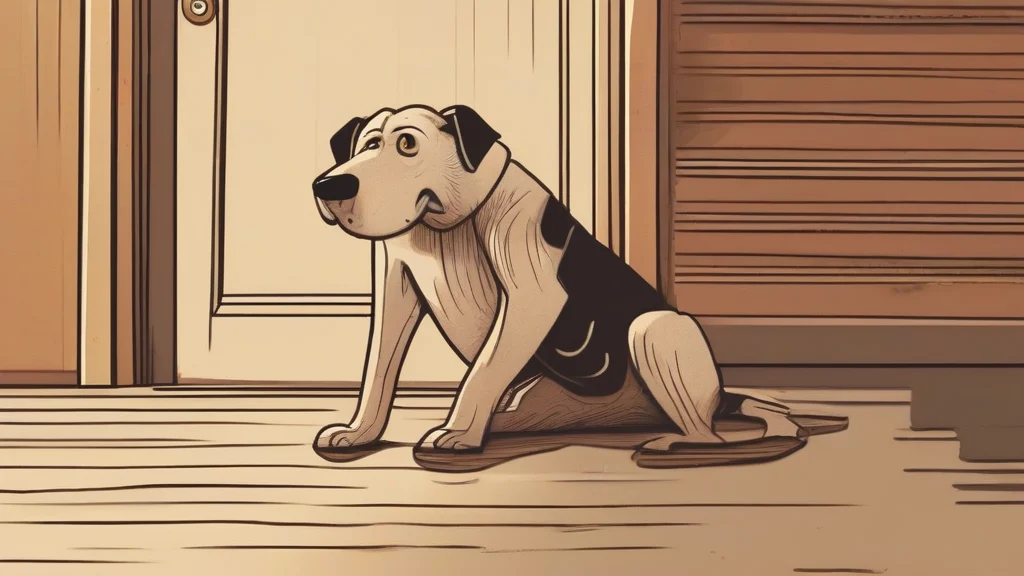
What does droopy mean?
Droopy is an informal English adjective describing things that hang or sag limply, whether from tiredness, moisture, gravity, or loss of firmness. A dog can have droopy ears, lettuce left too long in the fridge becomes droopy, and someone exhausted may speak with droopy eyelids or a droopy posture. The word derives from the verb droop, which itself entered Middle English with uncertain origins, combined with the familiar adjectival suffix -y. Because it so often describes faces, animals, and plants, droopy tends to carry a gentle, sympathetic, even endearing connotation rather than a critical one; calling a basset hound droopy sounds fond, not insulting. It pairs naturally with nouns like eyes, leaves, drawers, and shoulders. Its derived forms include the noun droopiness, the adverb droopily, and the participle drooping, which doubles as an ordinary adjective.
adjectiveHanging or sagging limply, especially from tiredness, weakness, or loss of firmness; having a drooping quality.
- Hanging or sagging limply, as from fatigue or lack of support.
- Looking or seeming weary, dejected, or lacking energy.
"The dog's droopy ears flopped over its eyes as it bounded across the garden."
"After the heatwave, the once-proud sunflowers stood droopy along the fence."
"He gave her a droopy smile and shuffled off to bed without an argument."
That sad-eyed cartoon bloodhound Droopy was drawn deliberately slow-moving — his name became shorthand for anything too tired to hold itself up.
Reviewed by Deb Chak, Editor. AI-assisted content curated by RJS Tech Solutions LLP.
Etymology of droopy
Droopy is formed from the verb droop plus the adjectival suffix -y, making it a straightforward native English formation. The verb droop appears in Middle English, though its ultimate origins remain uncertain, with possible connections to Scandinavian sources. The adjective droopy emerged later in English and remains firmly colloquial in tone.
Related word forms
How droopy is actually used
Informal and affectionate in register; common in everyday speech about pets, plants, clothing, and facial features. It often carries a sympathetic or endearing tone rather than a harshly critical one.
Easily confused with droopy
Drooping is a verb form describing the act of sagging, while droopy is an adjective describing something that habitually has a limp, sagging appearance.