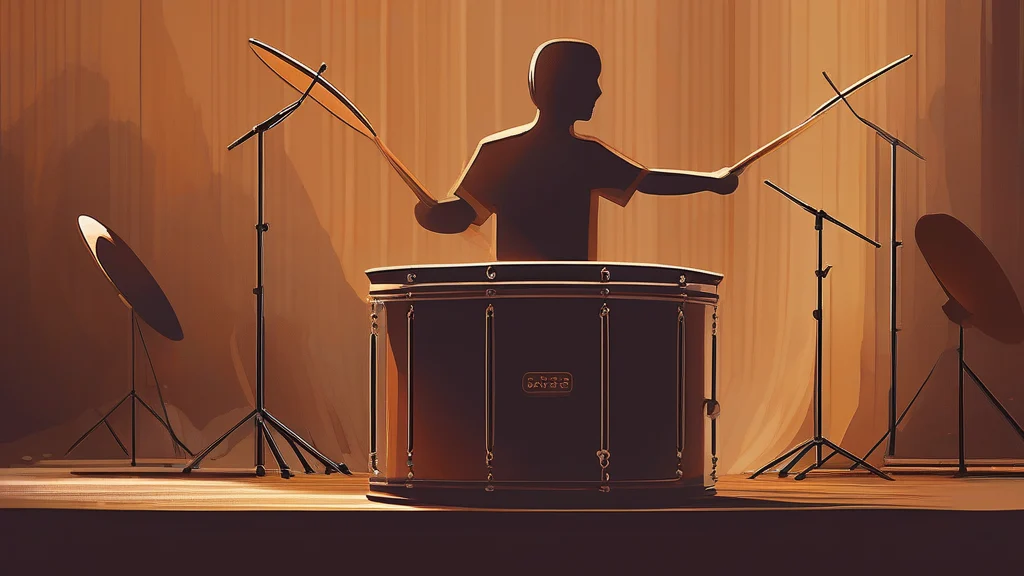
What does drum mean?
A drum is a percussion instrument consisting of a hollow body—usually cylindrical—with a taut membrane called a drumhead stretched across one or both ends, which is struck with the hands, sticks, or mallets to produce sound. Drums are among the oldest known instruments and form the rhythmic backbone of most musical traditions worldwide, from orchestral timpani to rock kits and marching bands. By extension, "drum" refers to any similar drumming sound, such as rain on a roof, and to large cylindrical containers used for shipping oil or chemicals. As a verb, to drum is to beat rhythmically, and figuratively to instill ideas through repetition ("drum into") or to generate enthusiasm or business through persistent effort ("drum up"). The word carries connotations of rhythm, insistence, and energy, making it vivid in both literal and metaphorical use.
A percussion instrument consisting of a hollow cylindrical shell with a stretched membrane struck by hand or sticks to produce sound.
"He has played the drum since he was eight years old."
A cylindrical container, usually metal, used for storing or transporting liquids.
"The factory stored its waste oil in fifty-five-gallon drums."
To strike or tap a surface rhythmically and repeatedly.
"Her fingers drummed impatiently on the desk during the long meeting."
To instill an idea or principle in someone through constant repetition.
"The coach drummed discipline into his players from the very first practice."
The plural "drums" refers either to multiple individual drums or, collectively, to the drum kit in popular music contexts (e.g., "he plays drums"). In the container sense, it denotes multiple barrels.
"The band's drummer set up his drums on the stage before soundcheck."
The word "drum" may be one of the oldest imitations in English — linguists think it simply echoes the sound the instrument makes, borrowed from Dutch "trom".
Reviewed by Deb Chak, Editor. AI-assisted content curated by RJS Tech Solutions LLP.
Etymology of drum
The word "drum" first appears in English in the sixteenth century, likely borrowed from Middle Dutch or Low German forms such as "trom" or "tromme", which are themselves thought to be imitative of the instrument's sound. It replaced older English terms like "tabor" in general usage. German retains the related "Trommel" and Dutch "trom", reflecting the shared West Germanic source. The verb followed soon after the noun, developing both its literal percussive sense and its figurative uses over the following centuries.
Related word forms
How drum is actually used
As a noun, "drum" covers both the musical instrument and the industrial barrel sense, which context always disambiguates. As a verb, the most frequent modern uses are figurative: "drum up" (to solicit or generate, e.g. business or support) and "drum into" (to teach persistently). The verb also appears intransitively for tapping sounds, as in fingers drumming on a table. The phrase "drum someone out" implies formal, often public expulsion, originally military. The word is neutral in register across all senses.
Easily confused with drum
"Drum" is a percussion instrument or its sound, while "thrum" means to play a stringed instrument in a monotonous, rhythmic way or to make a low vibrating hum.