
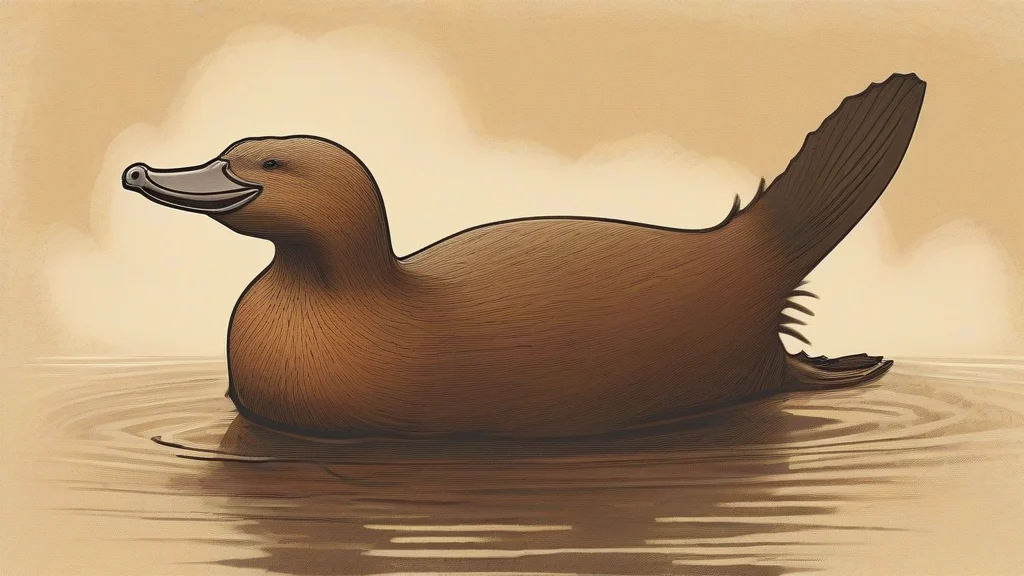
What does duckbill mean?
Duckbill is a compound noun formed from "duck" and "bill," applied to anything bearing the distinctive flat, spatulate shape of a waterfowl's beak. Its most familiar referent is the platypus, the remarkable egg-laying mammal of eastern Australia whose soft, rubbery snout resembles a duck's bill; early European naturalists who examined preserved specimens in the late eighteenth century famously suspected a taxidermic fraud. The word also serves paleontologists as an informal label for hadrosaurs, the large herbivorous dinosaurs whose broad, toothless snouts earned them the name duck-billed dinosaurs. Beyond zoology, duckbill appears attributively in everyday and technical vocabulary — duckbill caps, duckbill pliers, duckbill anchors, and duckbill check valves all share the characteristic two-part form that narrows and flattens like a beak. Versatile and vivid, the word lets writers evoke this recognizable shape economically, whether describing living animals, extinct giants, or humble hand tools.
nounA duckbill is the platypus, an egg-laying mammal of eastern Australia with a flat bill-like snout; by extension, the word also refers to any duck-billed dinosaur (hadrosaur) and to various objects shaped like a duck's bill.
- The platypus, an egg-laying monotreme mammal native to eastern Australia, named for its broad, flat, duck-like snout.
- Any hadrosaur, a large herbivorous dinosaur with a flattened, duck-like snout.
- Something shaped like a duck's bill, such as a duckbill cap, duckbill pliers, or a duckbill check valve.
"The duckbill paddled along the creek, its flat bill sifting mud for insect larvae."
"Early European naturalists could hardly believe the duckbill was real, since it seemed to combine features of bird, reptile, and mammal."
"He tipped back his duckbill cap and squinted at the horizon."
The standard plural simply adds -s. It is used equally for multiple platypuses, multiple hadrosaurs, or multiple duck-shaped objects such as tools or caps.
"The riverbank was riddled with burrows where duckbills raised their young."
When the first duckbill (platypus) specimen reached Britain in 1799, scientists were so baffled they suspected it was an elaborate hoax stitched together from a beaver and a duck.
Reviewed by Deb Chak, Editor. AI-assisted content curated by RJS Tech Solutions LLP.
Etymology of duckbill
Duckbill is a straightforward English compound combining "duck" — from Old English dūce, related to dūcan, meaning to dive or bend down — and "bill," from Old English bile, meaning a beak. The compound arose naturally to describe creatures and objects whose front end widens and flattens into a duck-like shape. It was applied to the platypus soon after Europeans encountered the animal in Australia in the late eighteenth century, and later extended informally to hadrosaur dinosaurs once their distinctive skulls were described in the nineteenth century. Both of its component roots are Germanic, giving the word an entirely native English pedigree rather than a Latin or Greek one.
How duckbill is actually used
As a standalone noun, "duckbill" most often means the platypus, though Australians more commonly use that name; "duck-billed platypus" is a fuller variant. In paleontology, "duckbill" informally denotes hadrosaurs. In compound uses such as duckbill pliers or duckbill valve, it functions attributively to describe a distinctive two-part, flattening shape. The word carries no strong register constraints but leans informal or technical depending on context.
Easily confused with duckbill
A duckboard is a slatted wooden board used as a walkway over wet ground, whereas a duckbill is an animal or a thing shaped like a duck's bill.