What does duckling mean?
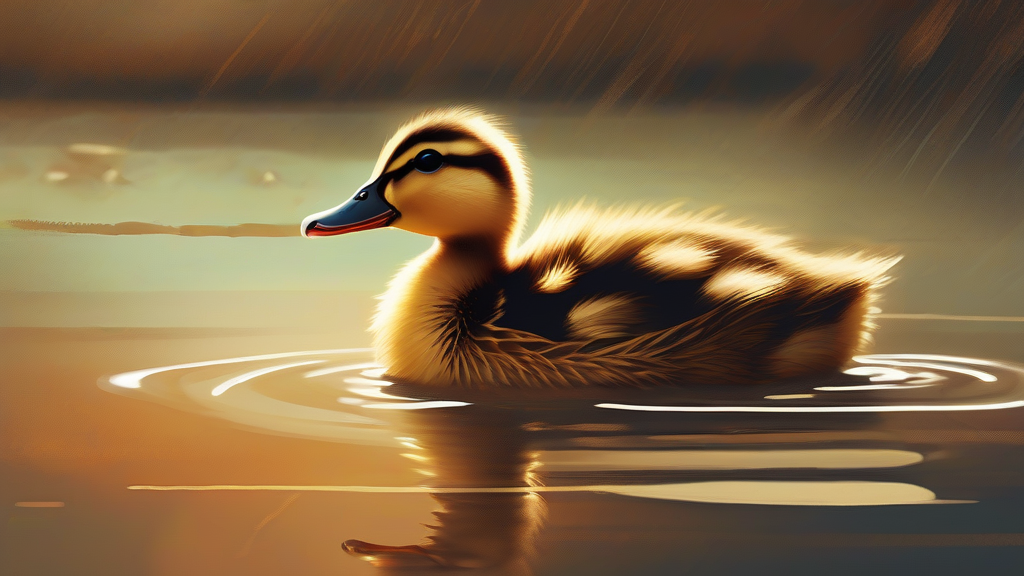
A duckling is a young duck, typically one still clad in the soft yellow or brownish down that precedes adult feathers. The word combines 'duck' with the Old English diminutive suffix '-ling', marking it as literally a small or youthful version of the bird. Ducklings appear frequently in nature writing and children's literature, where their habit of following their mother in a neat line has made them enduring symbols of innocence and new life. Beyond its literal sense, the word carries a well-known figurative meaning through Hans Christian Andersen's tale 'The Ugly Duckling', in which an awkward young bird matures into a graceful swan; hence calling someone an ugly duckling suggests hidden promise rather than genuine plainness. The term also appears on menus, where roast duckling denotes meat from a younger bird. Warm, familiar, and richly literary, it remains one of the most affectionate animal names in English.
A young duck, especially one still covered in soft down.
"Within a day of hatching, each duckling could swim confidently beside its mother."
Figuratively, a young child, especially one regarded with affection or one who develops late but beautifully (as in 'ugly duckling').
"Come along, little duckling — bedtime."
This figurative use is informal and endearing.
Standard plural; used both for multiple young birds and in the figurative sense.
"The reeds were alive with newly hatched ducklings."
Hans Christian Andersen's 'The Ugly Duckling' was never about a duck at all — the awkward grey hatchling turns out to be a swan, which is why the phrase now describes anyone whose true worth takes time to show.
Reviewed by Deb Chak, Editor. AI-assisted content curated by RJS Tech Solutions LLP.
Etymology of duckling
Duckling was formed in Middle English from 'duck' plus the Old English diminutive suffix '-ling', which marks a young or lesser example of something — the same suffix seen in words like underling, weakling, and earthling. It belongs firmly to the Germanic stock of English vocabulary rather than deriving from Latin or Greek roots. The compound has been in use since the medieval period and has remained stable in form ever since.
How duckling is actually used
Duckling carries warm, endearing connotations thanks to its association with fluffy baby birds and Andersen's fairy tale; it is informal to neutral in register. As a culinary term it can also refer to duck meat from a young bird.
Easily confused with duckling
A duck is the adult bird of either sex, while a duckling specifically denotes a very young one.
A gosling is a baby goose, whereas a duckling is a baby duck.