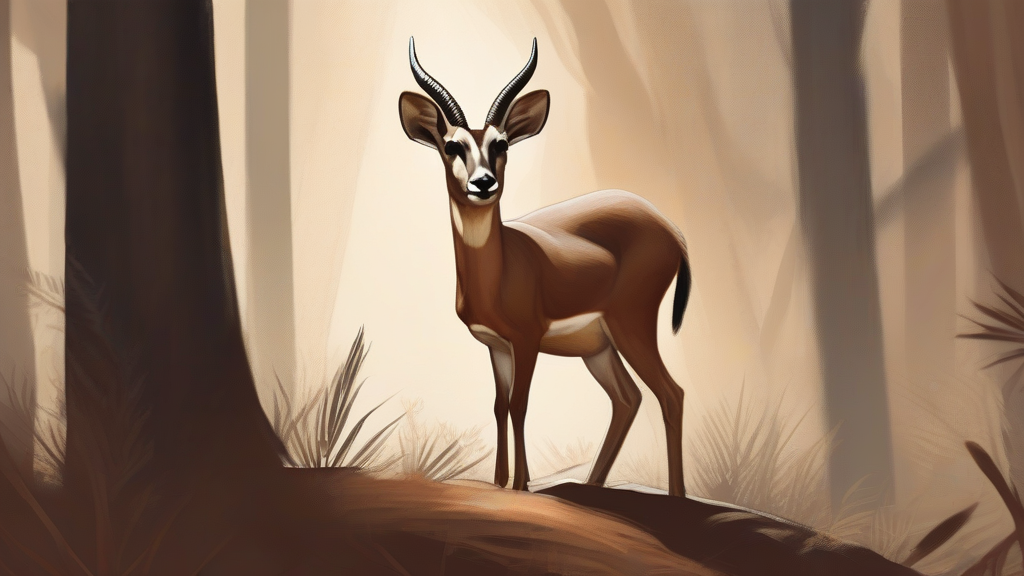
What does duiker mean?
A duiker is any of a group of small to medium-sized antelopes native to sub-Saharan Africa, classified mainly in the genus Cephalophorus along with a few related genera such as Sylvicapra. Duikers inhabit forests, woodland, and bushveld, and they take their common name from the Afrikaans word for 'diver', reflecting their characteristic habit of plunging headlong into dense vegetation at the first sign of danger rather than fleeing into the open. Species range from the tiny blue duiker, one of the smallest antelopes in Africa, to the substantially larger yellow-backed duiker. Shy, largely solitary, and often active at dawn and dusk, duikers feed on leaves, fruit, and seeds, and they serve as important prey for leopards, eagles, and pythons. The word appears chiefly in zoology, wildlife writing, and safari contexts, and it remains unfamiliar to most general readers outside those fields, which gives it a distinctly specialist flavour.
nounA small to medium-sized antelope of Africa belonging chiefly to the genus Cephalophorus, typically dwelling in forest or bushland and named for its habit of diving into cover when startled.
- Any of various small, shy antelopes of sub-Saharan Africa (genus Cephalophorus and related genera) that habitually dive into dense vegetation to escape predators.
"A blue duiker darted across the trail and vanished into the undergrowth before we could raise our binoculars."
"The yellow-backed duiker is the largest of its kind, weighing up to eighty kilograms."
"Leopards in the Congo Basin prey heavily on duikers, which form a staple of their diet."
Both the regular plural 'duikers' and the invariant 'duiker' are accepted, following the pattern of many African game-animal names.
"Camera traps recorded several duiker moving through the reserve overnight."
The duiker is named after the Dutch word for 'diver' — not because it swims, but because it dives headfirst into thick bush the instant danger appears.
Reviewed by Deb Chak, Editor. AI-assisted content curated by RJS Tech Solutions LLP.
Etymology of duiker
The word 'duiker' entered English in the late eighteenth century via South African Dutch (Afrikaans), in which 'duiker' means 'diver', derived from the Dutch verb 'duiken', 'to dive'. The name was applied by Dutch settlers to these antelopes because of their habit of diving into cover when alarmed. It shares its root with English 'duck' and 'dive' through the same Germanic verbal family relating to plunging or dipping motion, making it a rare case where an animal's behavioural tic is preserved directly in its name.
Related word forms
How duiker is actually used
Used mainly in zoological, ecological, hunting, and safari contexts; rare in everyday conversation outside these registers. Both 'duikers' and 'duiker' are accepted plurals, mirroring usage for many African game animals.
Easily confused with duiker
A dyer is a person who dyes fabric or other materials, whereas a duiker is a small African antelope; the words sound similar but share no meaning.