
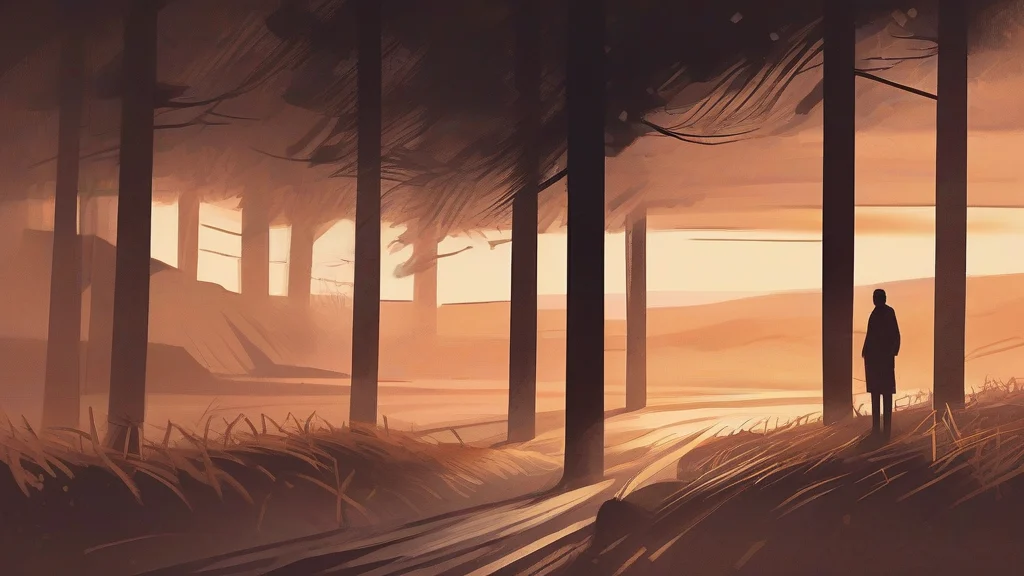
What does duskest mean?
Duskest has two related uses. In literary or descriptive language, it means “most dusky”: the darkest, dimmest, or most shadowy. A phrase such as “the duskest hour” uses it to place an image or scene at the height of fading light. Its better-known idiomatic use appears in “at the duskest,” especially in Southern US speech, where it means “at the very latest possible time” or “not a moment later.” The form is unusual beside the ordinary superlative duskiest, so duskiest will usually sound more natural when the intended sense is simply “most dusky.” Duskest is useful when a writer wants a compact, evocative, or deliberately colloquial phrase. The two senses share the idea of an endpoint: darkness reaches its deepest point in one, while the permitted time for action reaches its limit in the other.
adjectiveMost dusky, shadowy, or lacking in light. In the established idiom 'at the duskest,' it means at the very latest possible time.
- Most dusky, shadowy, or dark.
- In the idiom 'at the duskest,' the very latest possible time.
"At the duskest, the lighthouse was only a pale blur against the black water."
"The pines were at their duskest against the last orange strip of sky."
"We can leave at the duskest, but not a minute later."
Dusk already marks the fading of daylight, so duskest can mean either darkness at its deepest or the absolute deadline for getting something done.
Reviewed by Deb Chak, Editor. AI-assisted content curated by RJS Tech Solutions LLP.
Etymology of duskest
Duskest is a suffixed formation on dusk, with the ending -est marking a superlative. In its temporal idiom, dusk is extended metaphorically to mean the day's endpoint, so duskest indicates the very latest allowable point. Dusk descends from Old English dox and ultimately from the Germanic family of words for darkness; dusky is also an English derivative of this root, although its conventional superlative is duskiest.
How duskest is actually used
Duskest is literary and somewhat old-fashioned in its sense of 'most dusky'; the standard everyday superlative of dusky is duskiest. Its temporal sense is informal, distinctly regional, and most common in Southern US speech.
Easily confused with duskest
Duskiest is the standard superlative of dusky, while duskest is a less usual literary variant and also forms the regional idiom 'at the duskest.'