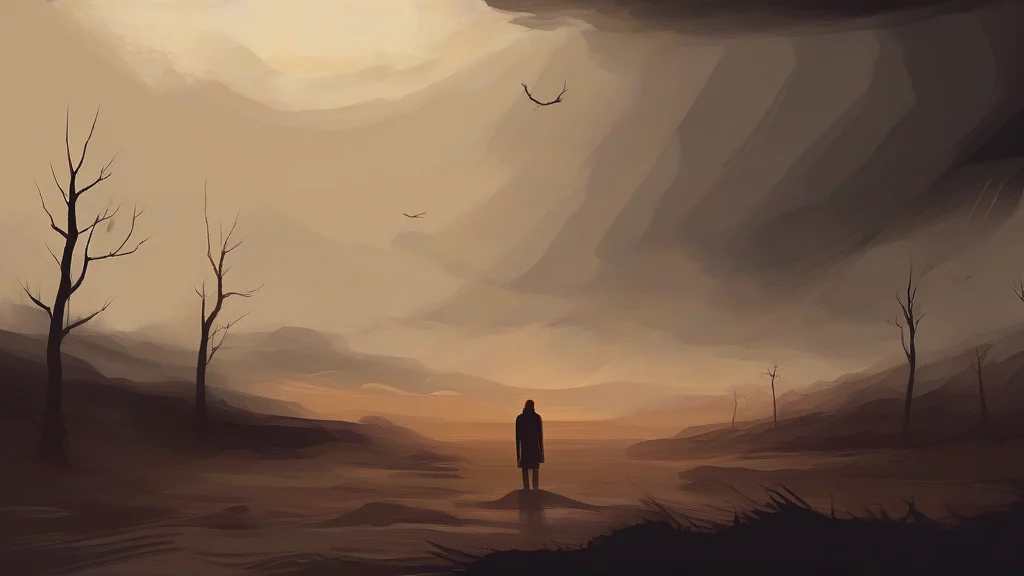
What does darkest mean?
"Darkest" is the superlative form of the adjective "dark," describing whatever has the least light, the deepest shade, or — figuratively — the greatest degree of gloom, secrecy, or despair. Literally, it identifies the point or place with minimal illumination: the darkest corner of a room, the darkest hour of night. Figuratively, it extends into emotional and moral territory, characterising periods of hardship ("her darkest days"), hidden motives ("his darkest secrets"), or bleak humour. The word is common across registers, appearing equally in literature, journalism, and everyday speech, and is anchored by well-established idioms such as "the darkest hour is just before the dawn," which offers reassurance that hope arrives at the moment of greatest difficulty. Because superlatives compare three or more entities, "darkest" normally takes the definite article and implies an implicit comparison within a group, making it a precise and evocative choice for writers seeking intensity.
adjectiveThe superlative form of "dark": having the least light, or the deepest in colour. Also used figuratively to describe the most unpleasant, sinister, or gloomy of a set of things.
- Having the least light; most lacking illumination.
- Deepest or most intense in colour.
- Most grim, sinister, depressing, or evil (figurative).
- Most secret, hidden, or obscure (figurative).
"She finally emerged from the darkest corner of the basement, blinking in the daylight."
"The village lay at the end of the valley, in the darkest recesses of the forest."
"Even in his darkest moments as a young writer, he never abandoned the manuscript."
Churchill famously rallied Britain by promising that the darkest hour comes just before the dawn — a proverb so old its origins are lost, yet it still anchors one of the most quoted speeches of the twentieth century.
Reviewed by Deb Chak, Editor. AI-assisted content curated by RJS Tech Solutions LLP.
Etymology of darkest
"Darkest" derives from "dark," an adjective of Germanic origin recorded in Old English (as "deorc"), meaning unilluminated or obscure. The superlative ending "-est" traces back through Middle English to Old English "-ost/-est," itself from Proto-Germanic comparative suffixes. Cognates appear across the Germanic family, such as Old High German "tarchanjan" (related forms) and Scandinavian relatives, though the exact Proto-Germanic root is debated among etymologists.
Related word forms
How darkest is actually used
"Darkest" is the standard suppletive-free superlative of "dark," used both literally and figuratively. In figurative use it carries strongly negative connotations of despair, secrecy, or moral bleakness, and appears frequently in fixed phrases such as "the darkest hour." As with most superlatives, it typically takes "the" and is used when comparing three or more things.
Easily confused with darkest
"Darker" is the comparative form describing one thing as having more darkness than another, while "darkest" is the superlative describing the greatest darkness of all.