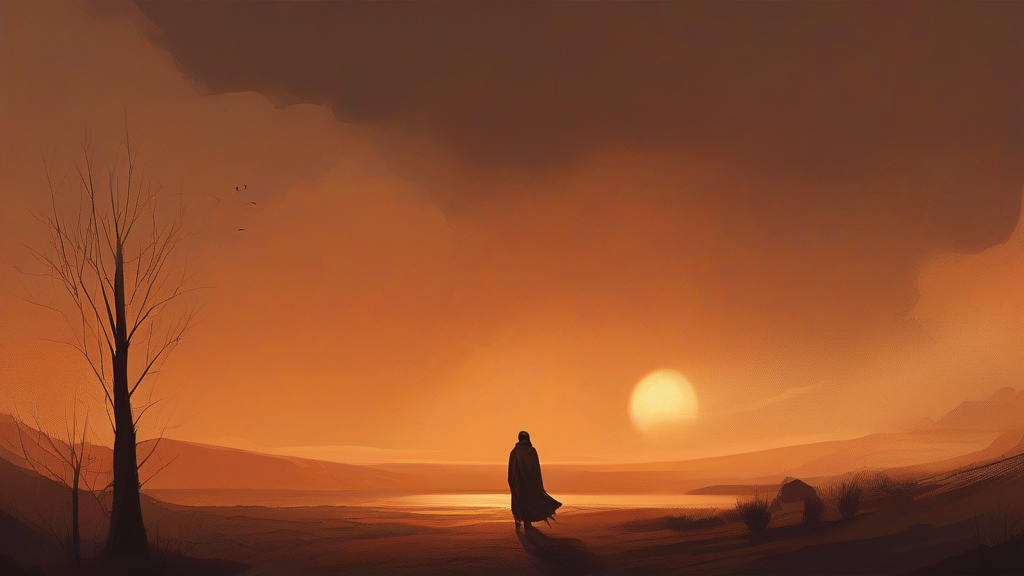
What does dusking mean?
Dusking is the present participle and gerund of the verb 'dusk', which describes the process of growing dark at the close of day. To say that the landscape is 'dusking' is to say it is fading into the low light of evening — an image most often found in poetry, nature writing, and older literary prose. The word derives ultimately from the Old Norse-influenced adjective 'dusk' meaning darkish, the same root that gives us 'dusky' and the common noun 'dusk', which names the darker phase of twilight after sunset. In everyday modern usage, 'dusking' is uncommon: most speakers treat 'dusk' strictly as a noun and would say 'it was getting dark' or 'night was falling'. When writers do reach for 'dusking', they typically do so for its atmospheric quality, evoking a gradual, gentle darkening rather than sudden blackness. It carries a quiet, contemplative connotation, well suited to descriptions of countryside, seasons, and memory.
verb (present participle and gerund of 'dusk')The present participle of the verb 'dusk', meaning to grow or become dark as evening approaches, or (less commonly) to darken something. It is also used, chiefly in literary or poetic register, as a gerund referring to the process of nightfall.
- Growing dark as evening falls (intransitive use of the verb 'dusk')
- Making or becoming dark; darkening something (transitive or general use)
- The process of nightfall itself, used as a noun-like gerund in literary writing
"The hills were dusking into shadow as the sun slipped below the ridge."
"By six o'clock in January the valley was already dusking toward night."
"She watched the sky dusking over the harbor from her window."
Reviewed by Deb Chak, Editor. AI-assisted content curated by RJS Tech Solutions LLP.
Etymology of dusking
The verb 'dusk' derives from the Middle English adjective 'dusk(e)', meaning tending to darkness or darkish in color, which itself traces back through Scandinavian influence (compare Old Norse 'duskr', dark) to Germanic roots. From this adjective arose both the noun 'dusk', denoting the darker part of twilight, and a verb meaning to grow or make dark, whose present participle is 'dusking'. Related forms include 'dusky' and 'duskiness'. The verb has never been frequent in standard English and survives chiefly in literary registers.
How dusking is actually used
Rare and markedly literary or poetic; ordinary English speakers almost always use 'dusk' as a noun ('at dusk') rather than employing the verb form. 'Dusking' may sound archaic, dialectal, or deliberately lyrical to modern ears.
Easily confused with dusking
'Dusk' is a noun meaning the darker stage of twilight, whereas 'dusking' is its verbal form describing the act of growing dark.