What does dustheap mean?
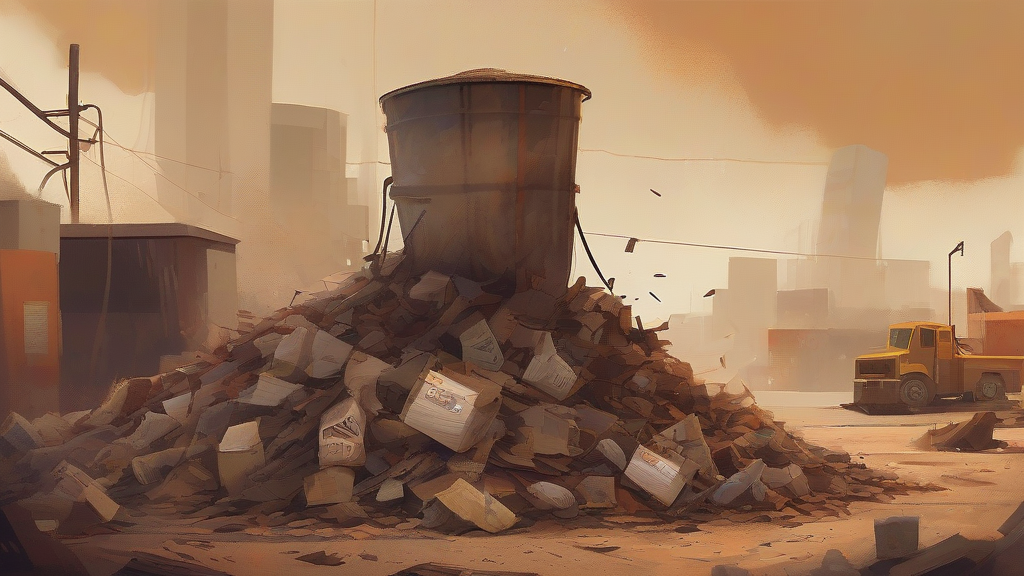
A dustheap is a pile of dust, ashes, cinders, or other household refuse — historically, the accumulated waste swept from homes before regular refuse collection existed. The word is formed from the plain English elements 'dust' and 'heap,' and it carries strong Victorian associations: in nineteenth-century cities, enormous dustheaps were a familiar feature of urban life, and scavengers made a living sorting them for coal cinders, rags, and other materials with resale value. Beyond its literal sense, dustheap has developed a vivid figurative use: to be 'thrown on' or 'consigned to' the dustheap is to be discarded as worthless or obsolete, and historians often speak of ideas, regimes, or technologies left 'on the dustheap of history.' Though still understood everywhere, the word now sounds somewhat old-fashioned or literary, especially outside British English, where it survives chiefly in rhetorical and historical contexts.
A heap or pile of dust, ashes, cinders, or household refuse.
"The chimney sweep hauled the season's soot and cinders out to the dustheap."
Historically associated with the Victorian dust-collecting trade, when household ashes were sold for brickmaking and road-building.
Figuratively, the state of being discarded as worthless, obsolete, or forgotten.
"The treaty was thrown onto the dustheap of failed diplomatic ventures."
Almost always appears in fixed figurative phrases such as 'the dustheap of history'; rarely used creatively outside these formulas.
Regular plural; used mainly when referring to multiple literal refuse piles across different locations, as in historical accounts of city sanitation.
"Enormous dustheaps rose at the edge of every industrial town."
Before municipal waste collection existed, entire economies of scavengers known as 'dustmen' and 'tosheroons' earned their living sifting through the city's dustheaps for coal ash and rags.
Reviewed by Deb Chak, Editor. AI-assisted content curated by RJS Tech Solutions LLP.
Etymology of dustheap
Dustheap is a straightforward English compound of 'dust,' from Old English 'dūst,' and 'heap,' from Old English 'hēap,' both Germanic roots inherited directly within English rather than borrowed from Latin or French. The compound arose naturally in Middle and Early Modern English as domestic waste was literally piled up for collection; it became especially prominent in the eighteenth and nineteenth centuries with urban dust-collecting trades. Its figurative sense of discardment grew out of the literal image of casting broken things onto the pile.
How dustheap is actually used
Somewhat dated or literary in register today; most common in British English, particularly in the figurative phrase 'on/to the dustheap of history.' In everyday speech, 'rubbish heap' or 'garbage pile' is more current.
Easily confused with dustheap
A scrapheap is specifically a pile of discarded metal or junk (often for machinery), while a dustheap refers more generally to dust, ashes, or household refuse.