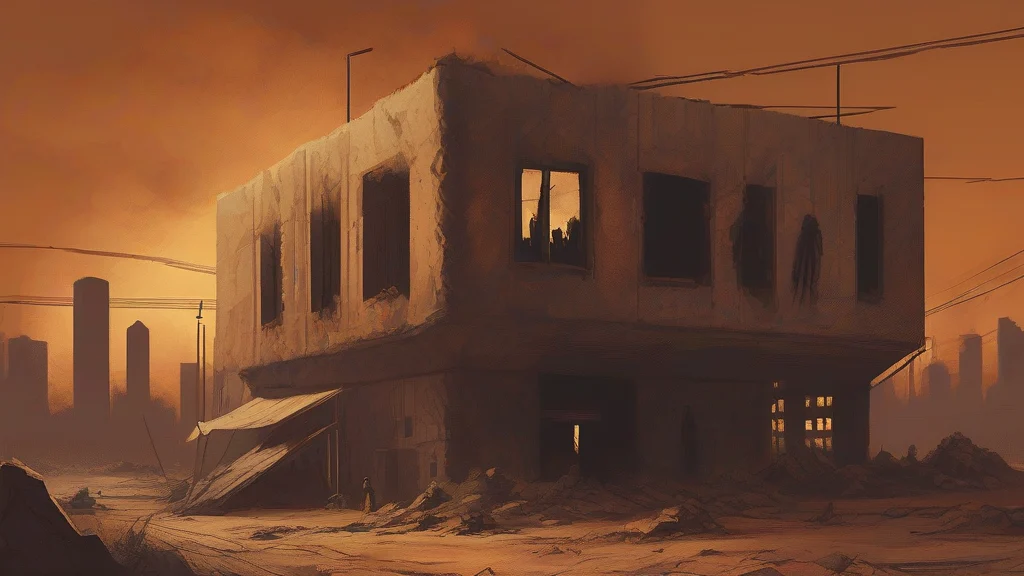
What does dystopia mean?
Dystopia is a noun describing an imagined society in which life is miserable, oppressive, or otherwise profoundly bad. It is generally understood as the opposite of a utopia — an idealized perfect society — though the term was formed later, by combining Greek roots meaning 'bad' with those of 'utopia'. Dystopias appear most often in fiction and political thought: novels such as George Orwell's Nineteen Eighty-Four and Aldous Huxley's Brave New World imagine worlds ruled by surveillance, propaganda, or engineered contentment, and these works have shaped how readers understand tyranny and control. Beyond literature, the word is used figuratively to criticize real trends, so that commentators might describe an authoritarian regime or an environmentally devastated region as dystopian. The adjective dystopian is especially frequent in phrases like 'dystopian future' or 'dystopian fiction'. Because it condenses complex fears about power, technology, and society into a single vivid term, dystopia remains one of the most useful words for discussing both speculative fiction and present-day anxieties about the direction of human affairs.
nounAn imagined state or society in which conditions are extremely bad, typically characterized by oppression, misery, or environmental ruin; the opposite of a utopia.
- An imagined place, state, or society in which life is deeply unpleasant, usually due to totalitarian government, environmental collapse, or other dehumanizing conditions.
- By extension, any real-world situation regarded as nightmarish or severely degraded.
"The novel imagines a dystopia in which a single corporation controls every aspect of citizens' lives."
"Orwell's Nineteen Eighty-Four depicts a dystopia where the state monitors every thought and word."
"Critics warned that unchecked surveillance could turn modern cities into a creeping dystopia."
Standard regular plural; used both literally for multiple imagined societies and figuratively for real situations likened to them.
"Twentieth-century literature produced many memorable dystopias."
The word 'dystopia' was coined as the exact opposite of Thomas More's 'utopia' — proof that for every dream of a perfect world, someone will imagine its nightmare twin.
Reviewed by Deb Chak, Editor. AI-assisted content curated by RJS Tech Solutions LLP.
Etymology of dystopia
Dystopia was formed from the Greek prefix 'dys-' (bad, abnormal) combined with '-topia', borrowed from Sir Thomas More's coinage 'utopia' (1516), itself derived from Greek 'topos' meaning 'place'. The word emerged in English in the mid-to-late 19th century, when writers sought a term for the opposite of More's ideal commonwealth, and it gained widespread currency in the 20th century alongside classics of dystopian fiction. It shares the Greek root 'topos' with words such as topography and topic, and stands as the negative counterpart to utopia.
Related word forms
How dystopia is actually used
The word is neutral in register and common in literary criticism, political commentary, and popular culture. It carries strongly negative connotations. The adjective form is 'dystopian', as in 'a dystopian vision of the future'.
Easily confused with dystopia
A utopia is an imagined ideal or perfect society, while a dystopia is its opposite — an imagined society marked by suffering and oppression.