
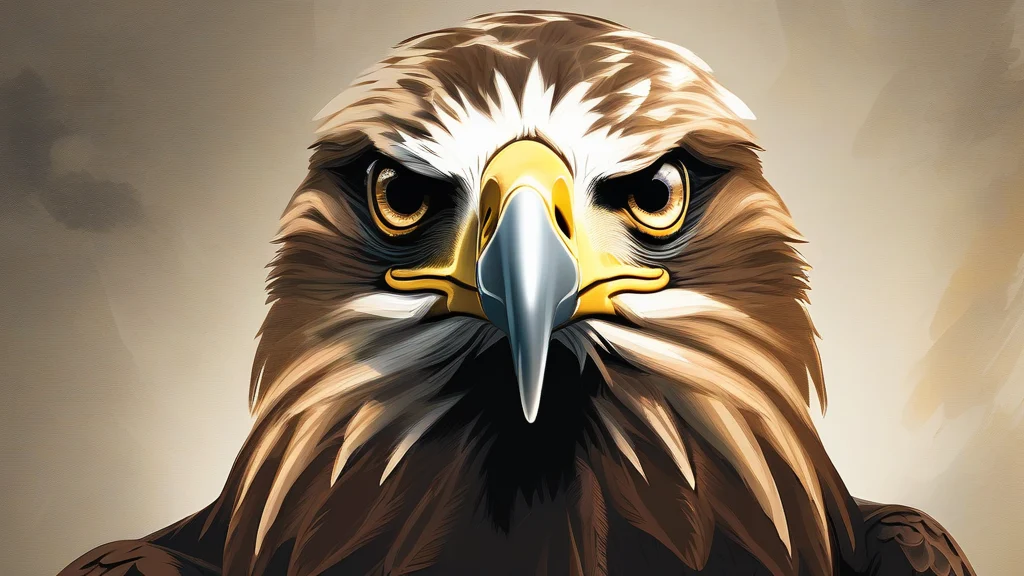
What does eagle mean?
An eagle is any of several very large, powerful birds of prey distinguished by their impressive size, hooked beaks, broad wings, extraordinary eyesight, and habit of soaring at great heights. Eagles are found across much of the world, with species such as the golden eagle of Eurasia and North America and the bald eagle of North America being especially well known. Because of their majesty and power, eagles have long served as emblems of nations and empires — the bald eagle has appeared on the Great Seal of the United States since 1782 — and they carry strong cultural connotations of freedom, courage, and far-sightedness. The word also has a well-established sporting use: in golf, an eagle is a score of two strokes under par on a single hole, a step better than a birdie. Figuratively, phrases like 'eagle-eyed' draw on the bird's legendary vision to describe exceptional alertness or perceptiveness, making the word useful in both literal and descriptive contexts.
nounA large, powerful bird of prey of the family Accipitridae, noted for its keen eyesight, broad wings, and soaring flight. In golf, an eagle is a score of two strokes under par on a single hole.
- Any of various very large, powerful birds of prey, especially those of the genera Aquila and Haliaeetus, known for keen eyesight and majestic soaring flight.
- A score of two strokes under par for a single hole in golf.
- A representation of an eagle used as an emblem or heraldic symbol, notably on national coats of arms such as that of the United States.
- (informal) An eagle-eyed person; someone with exceptionally sharp sight or vigilance.
"An eagle circled high above the valley, scanning the meadow for prey."
"The bald eagle has been the national emblem of the United States since 1782."
"She sank a long putt to eagle the final hole."
Regular plural; used for both multiple birds and, in golf, multiple eagle scores.
"Pairs of sea eagles can often be seen fishing along this stretch of coast."
Golfers borrowed 'eagle' as the next rung above a 'birdie' — so scoring one means you've done better than the bird itself.
Reviewed by Deb Chak, Editor. AI-assisted content curated by RJS Tech Solutions LLP.
Etymology of eagle
The word 'eagle' comes from Middle English 'eagle' or 'egle', borrowed from Old French 'aigle', which derives from Latin 'aquila', meaning eagle. It largely replaced the older native English term 'erne' (Old English 'earn'), which survives today mainly in dialect and place names. The same Latin root gives English 'aquiline' (meaning eagle-like, especially of a hooked nose), and the constellation Aquila preserves the original Latin form.
Related word forms
How eagle is actually used
As a noun, 'eagle' is neutral in register and appears in both everyday and formal contexts; it carries broadly positive connotations of strength, freedom, and keen vision. The golf sense functions both as a noun ('an eagle') and informally as a verb ('to eagle a hole').
Easily confused with eagle
A beagle is a small breed of scent-hunting dog, whereas an eagle is a large bird of prey.