What does earthmoving mean?
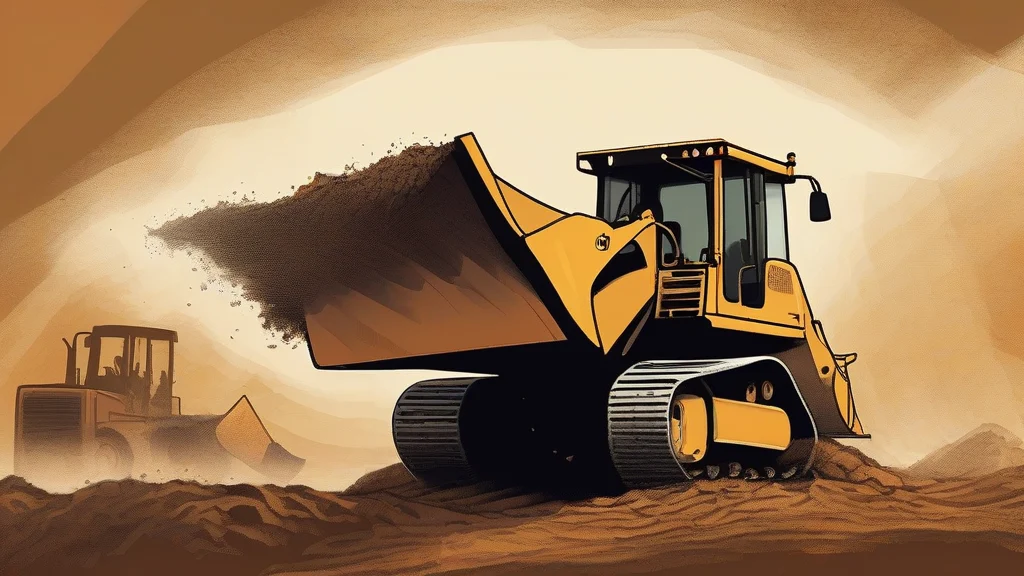
Earthmoving refers to the large-scale excavation, transport, and reshaping of soil and rock, usually accomplished with heavy machinery such as bulldozers, excavators, scrapers, and dump trucks. It functions both as an uncountable noun describing the activity itself — as in 'months of earthmoving preceded the foundation work' — and as an attributive adjective modifying equipment, contractors, or projects, as in 'earthmoving machinery'. The term belongs firmly to the vocabulary of civil engineering, road building, mining, and land development, where it denotes one of the earliest and most fundamental phases of any major construction effort. Because moving vast quantities of material is essential to nearly every large infrastructure project, earthmoving is a practical, widely understood term within the industry. Its related noun 'earthmover' names the powerful vehicles that perform this demanding work.
The activity of excavating, moving, and shaping large quantities of soil or rock, especially using heavy machinery.
"Extensive earthmoving was required to level the site for the new stadium."
Uncountable; used mainly in construction, engineering, and mining contexts.
Designed for or relating to the movement of earth, as of machinery or work.
"The dealership sells new and refurbished earthmoving equipment."
Almost always used attributively, directly before a noun.
Some of the biggest machines on Earth exist solely to do earthmoving — and the largest ones can move more dirt in a day than a thousand people could in a year.
Reviewed by Deb Chak, Editor. AI-assisted content curated by RJS Tech Solutions LLP.
Etymology of earthmoving
The word combines the ancient noun 'earth', from Old English 'eorþe' meaning ground or soil, with the verb 'move', from Old French 'moveir' and ultimately Latin 'movēre'. Compound formations pairing 'earth' with action words have long been productive in English, giving rise to terms like 'earthwork' and later 'earthmover'. The compound 'earthmoving' emerged alongside the mechanization of the construction industry in the nineteenth and twentieth centuries, when steam shovels and then diesel-powered machines made large-scale excavation routine.
Related word forms
How earthmoving is actually used
'Earthmoving' is most common in industrial, construction, and mining contexts, and is typically written as one word. It carries a technical, professional register rather than a literary one. As a noun it is uncountable, referring to the activity rather than individual instances.
Easily confused with earthmoving
Heartwarming means emotionally touching or uplifting, whereas earthmoving refers to the physical excavation and movement of soil or rock.