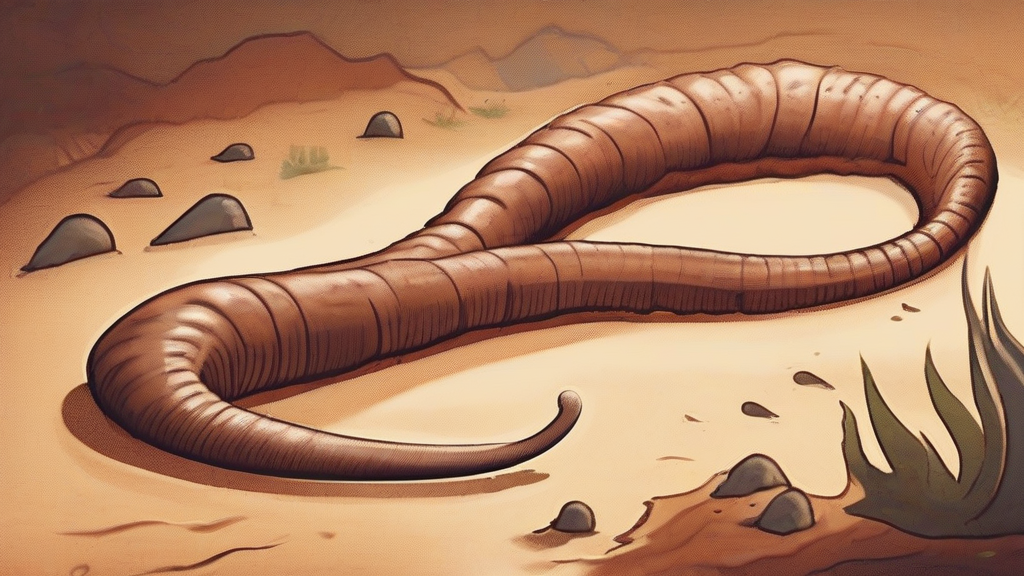
What does earthworm mean?
An earthworm is a long, cylindrical, segmented worm belonging chiefly to the family Lumbricidae, which lives in moist soil and feeds on decaying plant matter. As it burrows, an earthworm swallows organic material and excretes nutrient-rich casts while its tunnels aerate the ground, improving drainage and making nutrients more available to plants — services so valuable that gardeners and farmers often regard earthworm presence as a sign of healthy soil. The word is entirely concrete and literal: it names the animal itself rather than any quality or behaviour, appearing naturally in discussions of gardening, composting, ecology, and fishing bait. Charles Darwin devoted decades to studying these creatures, famously concluding that they have shaped human history more than any other animal by gradually burying archaeological remains and building fertile topsoil. Because of this quiet ecological importance, the humble earthworm has become a familiar symbol of soil health and natural fertility.
nounA terrestrial annelid worm of the family Lumbricidae (or similar), which burrows through soil, feeding on decaying organic matter and playing a vital role in soil aeration and fertility.
- Any of numerous terrestrial worms of the family Lumbricidae that burrow in soil and feed on organic matter, important for soil structure and fertility.
"The gardener turned over a spadeful of rich loam, revealing dozens of earthworms wriggling in the dark soil."
"Earthworms aerate the soil as they tunnel, allowing air and water to reach plant roots."
"She kept a small compost bin where earthworms broke down vegetable scraps into nutrient-rich castings."
Regular plural formation; no alternative plural forms exist.
"Healthy garden beds teem with earthworms beneath the surface."
Charles Darwin studied earthworms for over forty years and called them 'nature's ploughs' — without them, much of the world's fertile topsoil simply wouldn't exist.
Reviewed by Deb Chak, Editor. AI-assisted content curated by RJS Tech Solutions LLP.
Etymology of earthworm
The English word 'earthworm' is a transparent compound of Old English 'eorthe' (earth) and 'wyrm' (worm), formed within English to name the common burrowing worm found in soil. Both elements are ancient Germanic roots: 'eorthe' derives from Proto-Germanic '*erþō', and 'wyrm' from '*wurmiz', a root shared with German 'Wurm' and Dutch 'worm'. The compound follows the same pattern as other native formations like 'silkworm' and 'bookworm', and it has no Latin or Greek cognates, though scientific classification later assigned the group Latinate names such as Lumbricidae.
How earthworm is actually used
An entirely neutral, everyday term used in gardening, agriculture, ecology, and angling contexts; it carries no figurative or pejorative sense.
Easily confused with earthworm
A nightcrawler is a specific large type of earthworm (Lumbricus terrestris), whereas 'earthworm' is the broader general term for all such burrowing worms.