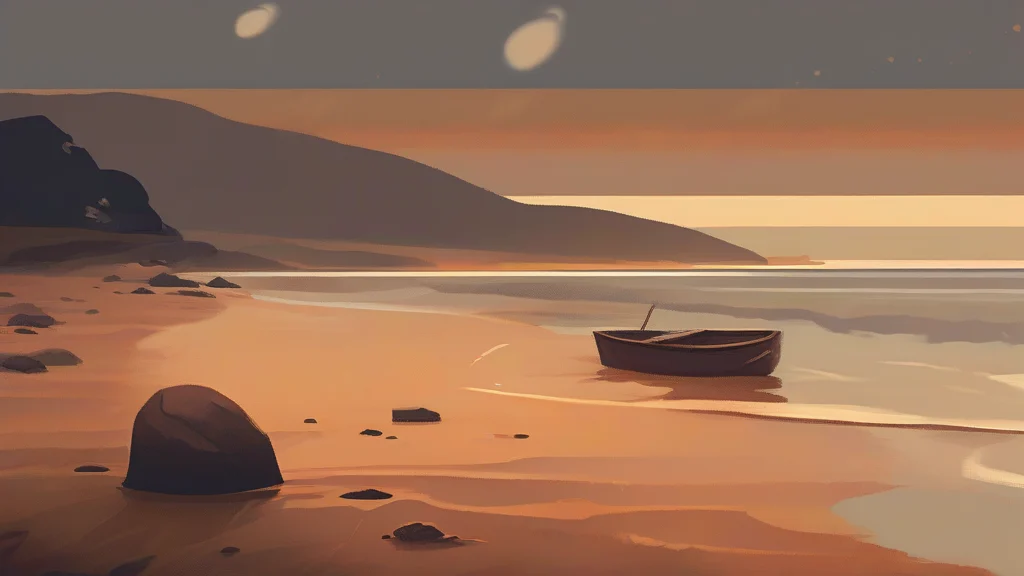
What does ebbing mean?
"Ebbing" refers primarily to the outward movement of the tide as the sea withdraws from the shore, the counterpart of the flood or rising tide. By extension, it describes any gradual decline or fading — of light, energy, courage, health, or public support — lending writing a quiet, elegiac quality. Because the motion of tides is slow, steady, and irresistible, "ebbing" conveys decline that feels natural rather than catastrophic. It appears most characteristically in phrases like "the ebbing tide," "her spirits were ebbing," or "support for the policy showed signs of ebbing." The word derives from the ancient Old English term for the receding sea, giving it deep roots in the language of seafaring. It remains common in both literal maritime contexts and literary or journalistic prose.
The action or process by which the tide flows back from the land; a state of decline or recession.
"They walked along the sands during the ebbing of the tide."
Frequently used in the fixed idiom "at a low ebb" to describe a period of weakness or depression.
Present participle of "ebb": to flow back from the flood stage; to decline gradually.
"His enthusiasm was visibly ebbing after hours of fruitless discussion."
In figurative use, typically applied to abstract quantities such as strength, hope, or popularity rather than physical objects.
As a mass noun denoting a process or condition, "ebbing" has no plural form; the countable noun "ebbs" belongs instead to the base form "ebb."
The word "ebb" is one of the oldest tide-words in English — it was already old when sailors spoke it over a thousand years ago.
Reviewed by Deb Chak, Editor. AI-assisted content curated by RJS Tech Solutions LLP.
Etymology of ebbing
The verb "ebb" comes from Old English "ebbian," derived from the noun "ebba" meaning the flowing back or low point of the tide, and it is cognate with similar forms in Old Frisian and related Germanic languages. It has been used in English since before the Norman Conquest, making it one of the oldest surviving tide-terms. The figurative sense — a gradual decline in abstract qualities — developed naturally out of the tidal metaphor and has been well established for centuries.
Related word forms
How ebbing is actually used
Most often encountered as part of the phrase "the ebbing tide" or in the fixed expression "at a low ebb." In figurative use it carries a literary, slightly melancholy tone, suggesting an inevitable, natural decline rather than sudden loss.
Easily confused with ebbing
"Ebbing" means receding or declining like a tide, while "eavesdropping" means secretly listening to other people's conversation — the words merely share a superficial sound pattern.