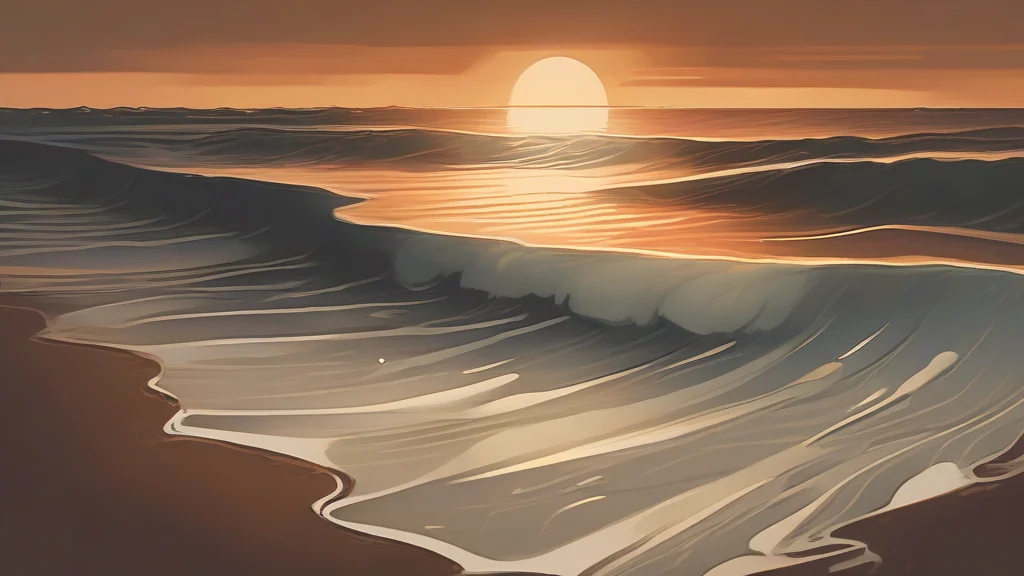
What does ebb mean?
Ebb describes the outward movement of the tide — the moment seawater pulls back from the shore — and, by extension, any slow, steady decline in strength, energy, popularity, or fortune. It functions as both a noun ('the ebb of the tide') and a verb ('his confidence ebbed'). The word appears most memorably in two established idioms: 'the ebb and flow,' which captures natural cycles of rise and fall, and 'at a low ebb,' meaning at one's weakest point. Because it implies gradual recession rather than sudden collapse, ebb carries a quieter, more literary tone than words like 'plummet' or 'crash'; it suits descriptions of tides, moods, relationships, economies, and reputations that fade slowly over time. Its maritime origins give it an evocative, almost poetic quality that makes it a favorite of essayists and novelists alike.
The receding movement of the tide out toward the sea; a low or declining state.
"They collected shells along the beach during the morning ebb."
Often used in the idiom 'at a low ebb' to describe someone or something at their weakest point.
To flow back or recede, as the tide does; to decline gradually in strength or intensity.
"As evening came on, the noise of the city began to ebb."
Standard plural form, though relatively uncommon in practice since 'ebb' is usually treated as an uncountable phenomenon.
"The fishermen timed their departure around the daily ebbs of the tide."
When your energy is 'at a low ebb,' you're borrowing language from sailors who watched the sea itself retreat.
Reviewed by Deb Chak, Editor. AI-assisted content curated by RJS Tech Solutions LLP.
Etymology of ebb
Ebb derives from Old English 'ebba,' meaning the flowing back of the tide, making it a genuinely ancient English word rather than a later borrowing. It shares roots with other Germanic languages, including related forms in Middle Dutch and Old Frisian, all describing tidal recession. The figurative sense — a decline in vigor or fortune — developed naturally from the literal maritime meaning and was well established by the early modern period.
Related word forms
How ebb is actually used
Commonly used both literally (about tides) and figuratively. The figurative use carries a slightly literary or reflective tone and often appears with prepositions like 'away' or phrases like 'at a low ebb.' Not typically used in casual everyday speech except in fixed idioms.
Easily confused with ebb
'Ebb' refers to the receding of a tide or a gradual decline, while 'eaves' are the overhanging edges of a roof.