
What does echinodermatous mean?
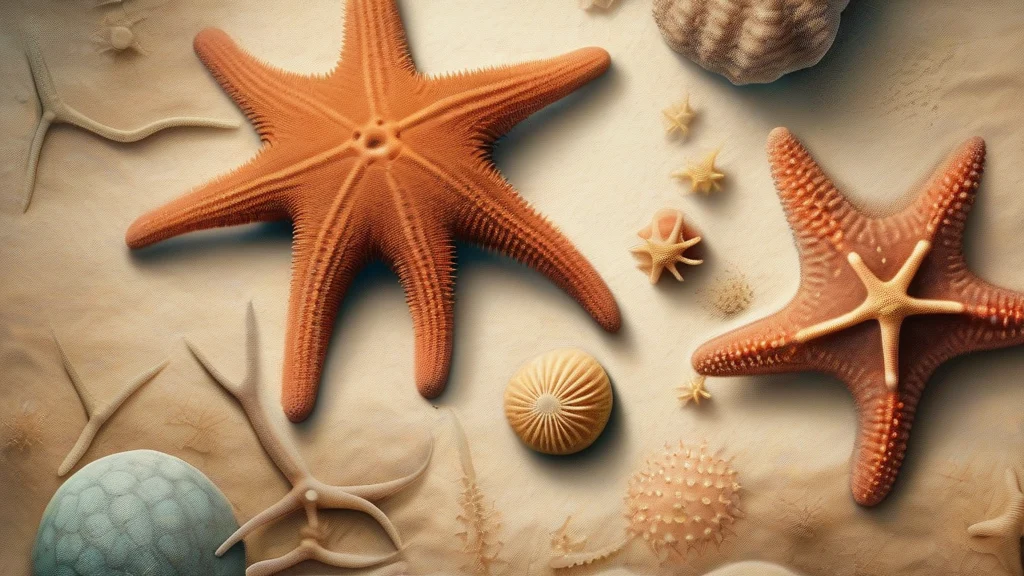
Echinodermatous is a specialized adjective meaning “relating to echinoderms,” members of the marine phylum Echinodermata. The group includes familiar animals such as starfish, sea urchins, brittle stars, sea cucumbers, and crinoids. The word is most often encountered in zoology, paleontology, taxonomy, and natural-history collections, where it may describe a characteristic biological feature, a collection of fossils, or the remains of echinoderms. Its name reflects the group’s often spiny appearance: the elements echino- and -derm- derive from Greek words associated with “hedgehog” and “skin.” Although the term can suggest something resembling a hedgehog, it is a technical taxonomic adjective rather than a general description of prickly surfaces. A reader encountering it should understand that it identifies something associated with this distinctive and evolutionarily important group of marine animals.
adjectiveRelating to or belonging to the Echinodermata, a phylum of marine animals including starfish, sea urchins, brittle stars, sea cucumbers, and crinoids. In zoological usage, it describes organisms, features, remains, or other material characteristic of this group.
- Relating to or belonging to the Echinodermata, a phylum of marine animals including starfish, sea urchins, brittle stars, sea cucumbers, and crinoids.
- Characteristic of or derived from echinoderms, as in fossil or biological material.
"The museum's collection contains numerous echinodermatous remains dating from the Jurassic period."
"The fossil assemblage included several echinodermatous fragments."
"Researchers documented the echinodermatous fauna inhabiting the deep reef."
Echinodermatous literally points to a hedgehog's skin: echino- means “hedgehog,” and -derm- means “skin.”
Reviewed by Deb Chak, Editor. AI-assisted content curated by RJS Tech Solutions LLP.
Where does echinodermatous come from?
Echinodermatous combines the combining form echino-, derived from Greek ekhinos, meaning “hedgehog,” with a form based on Greek derma, meaning “skin.” Its development is closely connected with the taxonomic name Echinodermata and related English zoological terminology such as echinoderm and echinoidean.
How echinodermatous is actually used
This is a formal, specialized zoological term. It is uncommon in general English and normally appears in scientific, taxonomic, paleontological, or museum contexts.
Easily confused with echinodermatous
Echinodermatous is an adjective relating to echinoderms, whereas echinoderm is a noun naming a member of the Echinodermata.