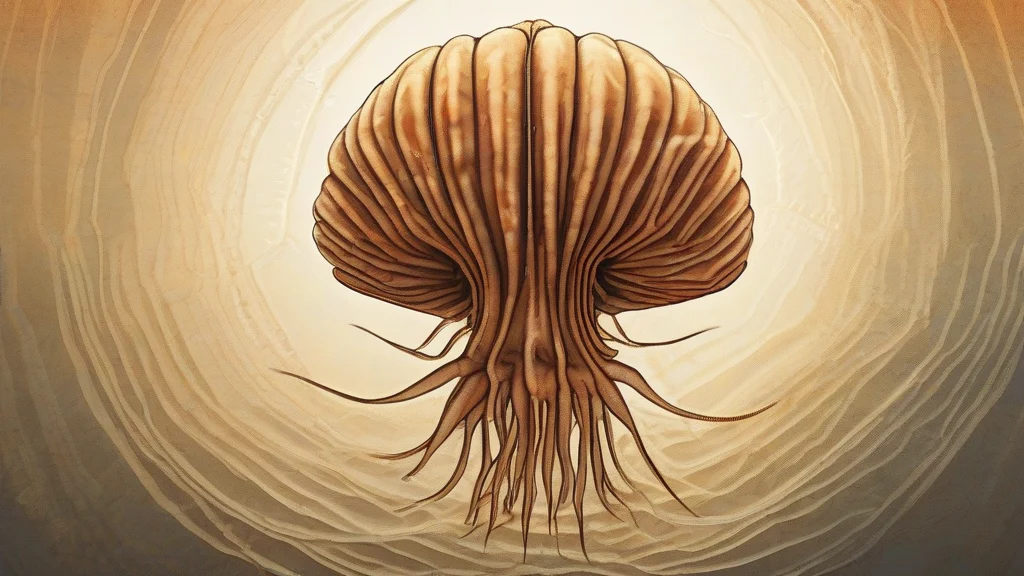
What does echinoderm mean?
An echinoderm is any member of the phylum Echinodermata, a group of exclusively marine invertebrates that includes familiar animals such as starfish (sea stars), sea urchins, sand dollars, brittle stars, and sea cucumbers. Echinoderms share several defining features: most adults display five-fold radial symmetry arranged around a central body axis, their bodies contain a calcareous internal skeleton often forming plates or spines, and they possess a unique water vascular system used for locomotion, feeding, and gas exchange. Found at every depth from intertidal pools to the deep seafloor, echinoderms play significant roles in marine ecosystems — some graze algae while others prey on shellfish. The word is primarily encountered in scientific, educational, and natural-history contexts. With a fossil lineage stretching back more than 480 million years, echinoderms are among the most distinctive and successful groups of ocean life.
nounA marine invertebrate of the phylum Echinodermata, characterized by a hard, spiny or plated skeleton and, typically, five-fold (radial) symmetry; the group includes starfish, sea urchins, sand dollars, sea cucumbers, and brittle stars.
- Any marine invertebrate belonging to the phylum Echinodermata, including starfish, sea urchins, sand dollars, brittle stars, and sea cucumbers, typically having five-part radial symmetry and a calcareous internal skeleton.
"The tide pools were teeming with echinoderms — sea stars clinging to the rocks beside purple urchins."
"Sea cucumbers are echinoderms that spend their lives grazing on the ocean floor."
"The fossil record shows echinoderms first appearing over 480 million years ago."
"Echinoderm" is a regular countable noun; the plural "echinoderms" is standard when referring to multiple individuals or species.
"Echinoderms such as sea urchins can dramatically reshape kelp forest ecosystems."
Every echinoderm is built like a five-pointed star — even the ones that look nothing like stars.
Reviewed by Deb Chak, Editor. AI-assisted content curated by RJS Tech Solutions LLP.
Etymology of echinoderm
The word "echinoderm" derives from modern Latin Echinodermata, formed from Greek roots: "echinos," meaning hedgehog or sea urchin (a reference to the spiny exterior), and "derma," meaning skin. The term entered English scientific usage in the early nineteenth century as zoologists formalized the classification of this group. Related words sharing the Greek root "echinos" include echidna (the spiny monotreme) and echinate (spiny).
Related word forms
How echinoderm is actually used
"Echinoderm" is a technical term used chiefly in biology, paleontology, and oceanography rather than everyday conversation. It is countable, with the standard plural "echinoderms," though "echinoderm" can also function attributively as in "echinoderm species." The formal phylum name is Echinodermata.
Easily confused with echinoderm
An echidna is a spiny egg-laying mammal from Australia and New Guinea, while an echinoderm is a spiny marine invertebrate such as a sea urchin or starfish.