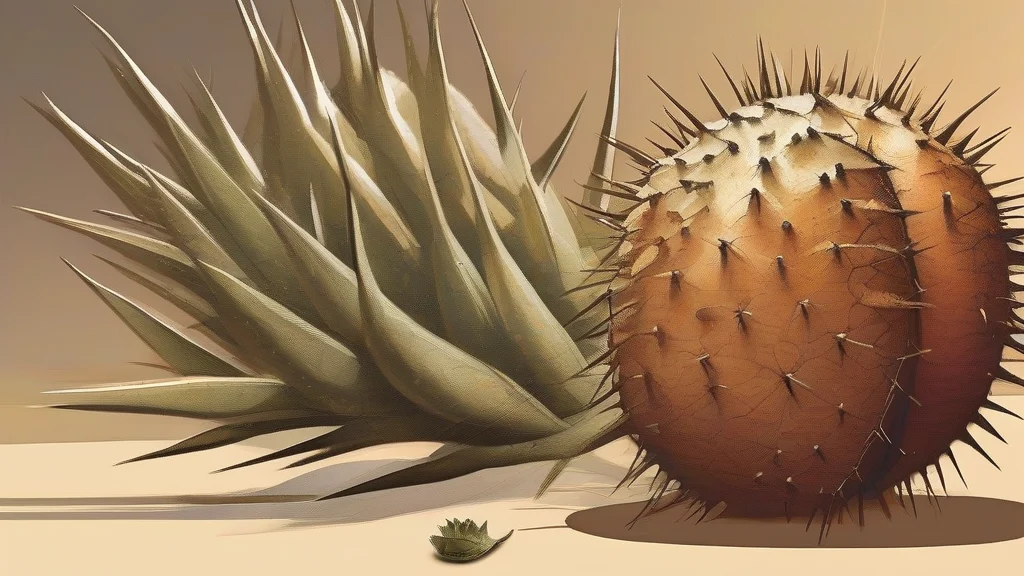
What does echinate mean?
Echinate is a technical adjective meaning covered with spines or prickles, used most often by botanists and zoologists to describe plant parts, seeds, fruits, or animal structures that bristle with stiff, sharp projections. A chestnut burr or a burdock's clinging seed heads are classic echinate forms, as are many pollen grains when viewed under a microscope. The word derives from the Latin echinatus, itself rooted in the Greek echinos, meaning hedgehog — so to call something echinate is literally to say it resembles a hedgehog in its armature. It belongs to formal, scientific register and rarely appears in casual conversation, but it offers precision that everyday words like prickly or spiny lack, distinguishing fine, bristle-like spinules from larger thorns. For readers of natural history, taxonomy, or paleobotany, echinate is an exact and evocative descriptor worth knowing.
adjectiveCovered with spines or prickles; bristling with sharp points. Used chiefly in botany and zoology to describe fruits, seeds, shells, or other structures bearing stiff, spine-like projections.
- Covered with spines, prickles, or stiff bristle-like projections; especially of plant parts such as fruits and seeds.
- More generally, resembling a hedgehog in being beset with spines or sharp points.
"The echinate seed pods clung tenaciously to the hiker's socks."
"The chestnut burr is a familiar echinate structure that protects the developing nut."
"Under magnification, the pollen grains proved distinctly echinate, studded with fine spinules."
Echinate literally means "hedgehog-like" — botanists borrowed it straight from the Greek word for the spiky little mammal.
Reviewed by Deb Chak, Editor. AI-assisted content curated by RJS Tech Solutions LLP.
Etymology of echinate
Echinate comes from the Latin echinatus, meaning "like a hedgehog," formed on echinus, the Latin word for both the hedgehog and the sea urchin. The Latin term itself was borrowed from the Greek echinos, which named the same spiny creatures. English adopted the word around the early seventeenth century, and its root also survives in scientific coinages such as echinoderm (the phylum of sea urchins and starfish) and echidna, the spiny Australian mammal named for the same Greek creature.
How echinate is actually used
A technical term found mainly in botanical and zoological literature rather than everyday speech. It carries a precise, descriptive connotation — the projections are typically stiff and bristle-like rather than large woody thorns — and lends a learned, scientific tone to writing.
Easily confused with echinate
"Echinoid" is a noun naming a sea urchin or related echinoderm, while "echinate" is an adjective simply describing anything covered in spines.