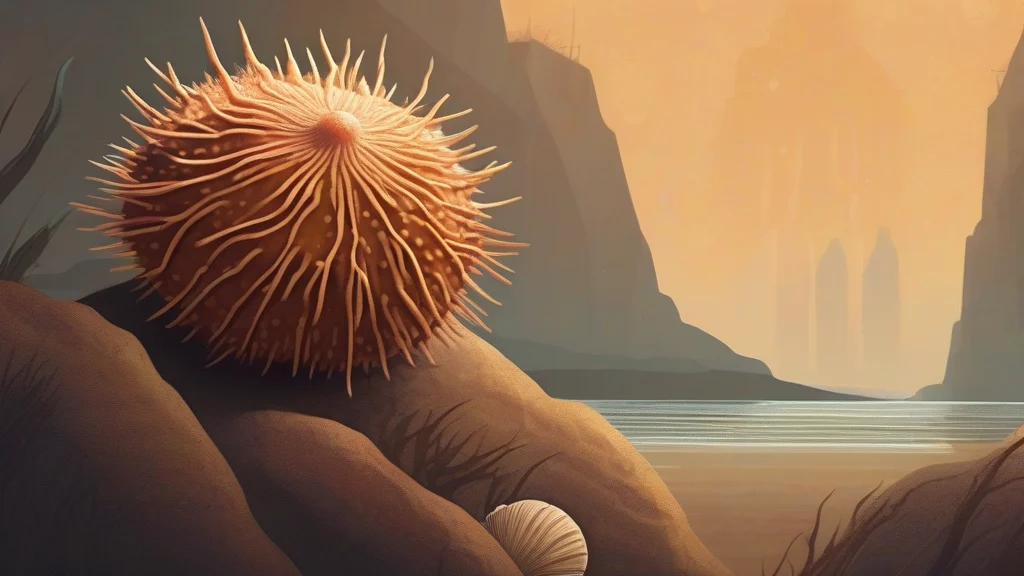
What does echinus mean?
Echinus refers primarily to the sea urchin, a small marine invertebrate with a round, spiny shell that grazes on algae along rocky coastlines; in scientific usage the capitalized form Echinus designates a particular genus within the class Echinoidea. The word carries a second, quite different sense: in classical architecture, an echinus is the cushion-like convex moulding that forms the curved portion of a column capital beneath the square abacus, a feature especially characteristic of the Doric order and often enriched with the egg-and-dart ornament. Both meanings trace back to the same source — the Greek word for hedgehog — since the sea urchin's bristling spines reminded ancient observers of that prickly mammal. Today echinus survives mainly in technical registers, appearing in marine biology texts and architectural histories alike.
A sea urchin; specifically, a member of the genus Echinus among the class Echinoidea.
"The rocky shallows teemed with echini clinging to every available surface."
The Latin plural echini is standard; 'echinuses' also occurs but is less common. Capitalized Echinus is reserved for formal zoological classification.
In classical architecture, the convex moulding forming the lower, rounded part of a column's capital, typically carved with an egg-and-dart pattern.
"Restorers carefully recut the weathered echinus to match the temple's surviving Ionic capitals."
This sense appears almost exclusively in discussions of Greco-Roman architecture and its revivals.
Both the Latinate 'echini' and the anglicized 'echinuses' are accepted, but 'echini' is the more traditional and common form in scholarly writing.
"Along the kelp forest floor, hundreds of echini grazed undisturbed."
The Greeks called the sea urchin a 'hedgehog' — and that same root gave us the word echinoderm, literally 'spiny-skinned'.
Reviewed by Deb Chak, Editor. AI-assisted content curated by RJS Tech Solutions LLP.
Etymology of echinus
Echinus comes from Latin echinus, borrowed from Greek ekhinos meaning 'hedgehog' or 'sea urchin', so named for its spiny exterior. English adopted it in the late sixteenth century, applying it first to the sea urchin and later to the similarly rounded, bulging element of a column capital in classical architecture. The same Greek root underlies related terms such as echinoderm ('spiny-skinned') and echinate ('prickly'). Its standard plural is the Latinized form echini.
How echinus is actually used
A technical term used mainly in zoology and classical architecture; in everyday speech 'sea urchin' is far more common. In zoological contexts it appears chiefly in scientific writing, where capitalized Echinus denotes the genus name.
Easily confused with echinus
An echidna is a spiny Australian monotreme mammal (the anteater-like animal); an echinus is a marine sea urchin — both names derive from Greek 'hedgehog', but they refer to entirely different creatures.