
What does echinoid mean?
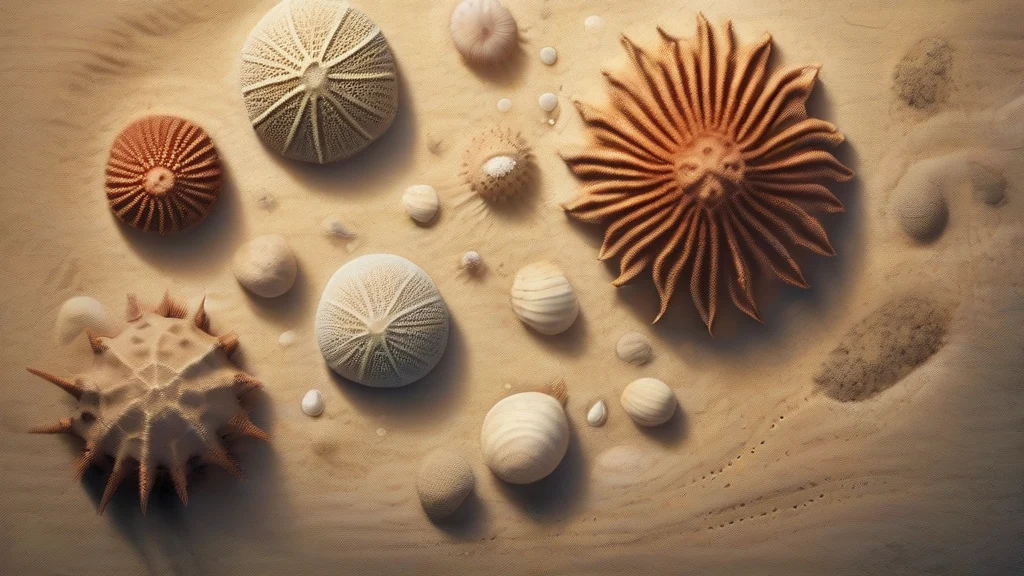
An echinoid is any member of Echinoidea, a class of marine animals within the larger group known as echinoderms — the same phylum that includes starfish and sea lilies. Familiar living examples include the spherical, spiny sea urchins and their flattened relatives the sand dollars and heart urchins. The name derives from the Greek word for hedgehog, an apt description of an animal whose body is often covered in mobile spines used for defence and locomotion. Echinoids have a hard internal shell, called a test, made of interlocking plates, and this durable structure means they fossilise readily: echinoid remains are common in chalk and limestone deposits and are important index fossils for dating rocks. The term is primarily technical, appearing in zoology, paleontology, and natural-history writing, where it functions both as a noun and as an adjective describing anything related to the group.
A marine invertebrate of the class Echinoidea, comprising sea urchins, heart urchins, sand dollars, and their fossil relatives.
"The chalk beds yielded dozens of well-preserved echinoids from the Cretaceous period."
Of, relating to, or characteristic of echinoids.
"The study examined echinoid diversity across ancient reef ecosystems."
The adjective use is largely confined to scientific literature, e.g. "echinoid test," "echinoid fauna."
Regular English plural. When referring to the class collectively in taxonomy, the singular-form Latin name "Echinoidea" is used instead.
"Irregular echinoids diversified rapidly during the Jurassic period."
The spiky 'hedgehogs of the sea': the word echinoid comes from the Greek for hedgehog, because a living sea urchin bristles just like one.
Reviewed by Deb Chak, Editor. AI-assisted content curated by RJS Tech Solutions LLP.
Where does echinoid come from?
"Echinoid" derives from the Greek "echinos," meaning hedgehog or sea urchin, combined with the suffix "-oid," meaning "resembling" or "in the form of." The Greek root was adopted into scientific Latin as "Echinus" and later formalised as the class name Echinoidea in modern zoological classification. The same root appears in other scientific terms such as "echinoderm" (spiny-skinned), the phylum to which echinoids belong.
How echinoid is actually used
"Echinoid" is chiefly used in scientific, paleontological, and natural-history writing rather than everyday speech. In casual contexts people say "sea urchin" or "sand dollar." The adjective sense is common in phrases like "echinoid skeleton" or "echinoid fauna."
Easily confused with echinoid
An echinoderm is any member of the broader phylum (including starfish, brittle stars, and crinoids), whereas an echinoid is specifically a member of the class Echinoidea — sea urchins, sand dollars, and their relatives.