
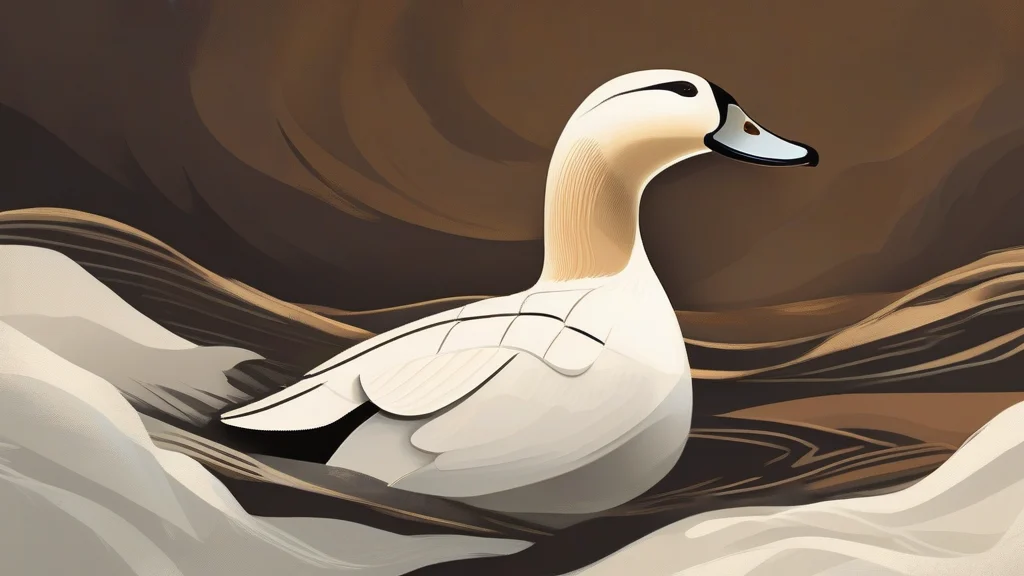
What does eider mean?
An eider is a large sea duck found along the cold coastlines and Arctic waters of northern Europe, North America, and Asia. Best known are the common eider and the king eider, striking birds whose plumage ranges from black and white in the males to mottled brown in the females. The word is most familiar to many people through 'eider down,' referring to the exceptionally soft, warm breast feathers the ducks pluck to line their nests. For centuries, particularly in Iceland and Scandinavia, these feathers have been gathered from nests without harming the birds, making eider down one of the most prized and expensive natural insulating materials for comforters and pillows. In everyday English, 'eider' appears chiefly in discussions of birds, wildlife, or luxury bedding, giving it associations of warmth, northern wilderness, and natural quality rather than casual conversation.
A large sea duck of northern coastal regions (genus Somateria), especially the common eider, noted for its soft down feathers.
"Thousands of eider migrate south along the Norwegian coast each autumn."
The soft, fine down of the eider, used as filling for quilts, duvets, and pillows (usually in the phrase 'eider down').
"The shop specialized in duvets filled with pure Icelandic eider down."
In this sense the word almost always appears as part of the compound 'eider down' or 'eiderdown' rather than alone.
Both forms are accepted; 'eider' is often left unchanged when speaking of the ducks collectively, while 'eiders' is common in ordinary prose.
"Flocks of eider wintered in the sheltered bay."
The eider's feathers are so warm that for centuries people have collected them straight from the nests of wild ducks in Scandinavia — without harming a single bird.
Reviewed by Deb Chak, Editor. AI-assisted content curated by RJS Tech Solutions LLP.
Etymology of eider
The word 'eider' entered English in the late 17th century, borrowed from Low German 'Eider,' which itself derives from Old Norse 'æðr,' the name of this duck. It reflects the Scandinavian origins of both the bird and the trade in its famous down. The compound 'eiderdown' arose shortly afterward and remains the most common way English speakers encounter the word today.
Related word forms
How eider is actually used
Mostly encountered in ornithological contexts or in the compound 'eider down.' The plural is typically unchanged ('eider') when referring to the birds collectively, though 'eiders' also occurs.
Easily confused with eider
'Either' means 'one or the other of two,' while an 'eider' is a type of sea duck; the words merely resemble each other in sound and spelling.