What does eland mean?
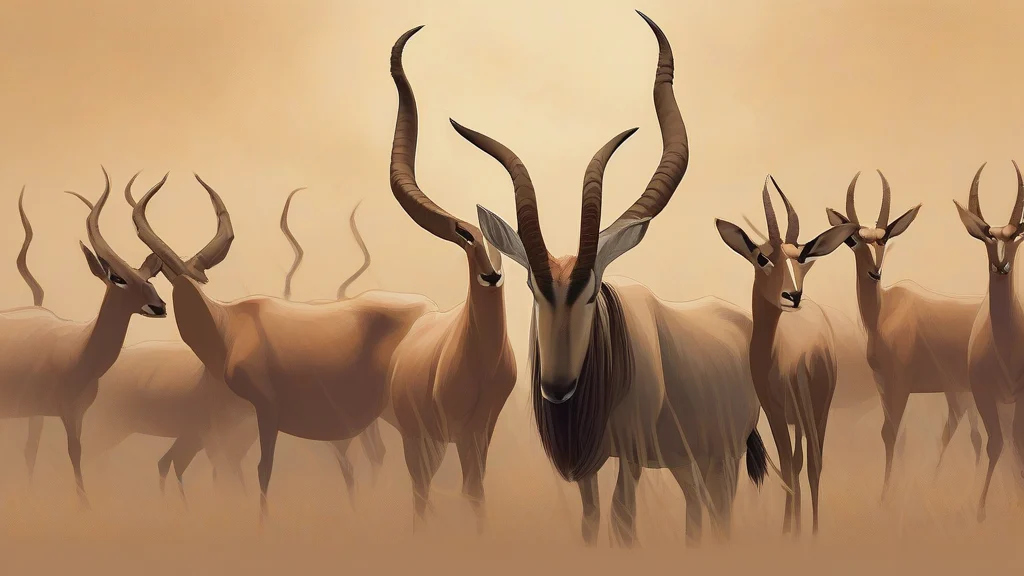
The eland is the largest species of antelope in the world, native to the grasslands, woodlands, and savannas of eastern, southern, and western Africa. Two species are recognised: the common eland (Taurotragus oryx) and the giant eland (Taurotragus derbianus). Bulls can stand nearly two metres at the shoulder and weigh upwards of nine hundred kilograms, yet these animals are remarkably agile, capable of jumping considerable heights despite their bulk. Elands are distinguished by their long, spiralled horns, loose skin folds on the neck (the dewlap), and coats ranging from tawny brown to bluish-grey. Unusually for large wild game, elands have proven suitable for semi-domestication: in parts of southern Africa they have been farmed for their rich milk, lean meat, and hides. The plural may be written either "eland" or "elands," with collective usage common in wildlife contexts. The word entered English in the late eighteenth century from Dutch, itself borrowed from a Khoekhoe language of southern Africa.
nounA large African antelope of the genus Taurotragus, with long spiral horns, a dewlap, and a tan to greyish coat; the largest living antelope.
- Either of two large African antelopes of the genus Taurotragus: the common eland (Taurotragus oryx) or the giant eland (Taurotragus derbianus), noted for their size, spiralled horns, and loose dewlap.
"A herd of elands moved slowly across the savanna at dusk."
"The common eland is widely kept as a semi-domesticated animal in parts of southern Africa for its milk and meat."
"Spotting a giant eland in the wilds of Senegal is a rare treat for even seasoned safari-goers."
The plural is most commonly left unchanged ("a herd of eland"), especially in zoological contexts; "elands" is also fully accepted.
"Several eland grazed near the waterhole before dawn."
The eland is the biggest antelope on Earth — a bull can weigh over 900 kilograms, yet it can clear a two-metre fence from a standing start.
Reviewed by Deb Chak, Editor. AI-assisted content curated by RJS Tech Solutions LLP.
Etymology of eland
The English word "eland" was borrowed from Dutch "eland," meaning the same animal, during the period of Dutch colonial presence at the Cape of Good Hope. The Dutch term itself derives from Khoekhoe (Khoikhoi) e-landa, reflecting early European contact with southern African languages. The word has been used in English since the late eighteenth century, when European naturalists began describing the fauna of the Cape region systematically.
How eland is actually used
"Eland" functions as both singular and plural in natural usage ("a herd of eland"), though "elands" is also acceptable. The word carries a neutral, largely zoological register, appearing most often in wildlife writing, safari contexts, and conservation literature.
Easily confused with eland
An 'eland' is a large African antelope, while an 'island' is a landmass surrounded by water; the two words merely rhyme.
An 'eland' is a large African antelope of the genus Taurotragus, whereas an 'elk' is a large deer found in North America and Eurasia (called moose in North America).