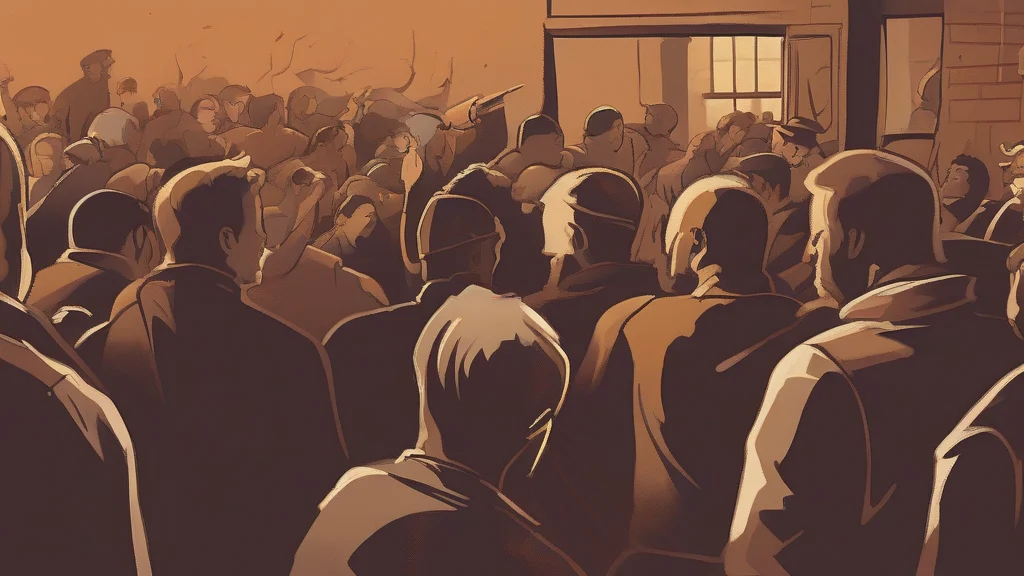
What does elbowed mean?
"Elbowed" is chiefly the past tense and past participle of the verb "to elbow," meaning to push, jostle, or force one's way forward using the elbows. Its most familiar use is figurative: people elbowed their way through crowds, into conversations, or out of trouble, a phrasing that suggests blunt, determined, sometimes discourteous self-assertion. The word also has a more literal sense — striking someone with the elbow, common in sports reporting — and a rare adjectival sense describing something bent at an angle, as in plumbing or engineering contexts. Derived from "elbow," an Old English word for the arm joint, it carries connotations of physicality and hustle; to say someone "elbowed their way to the front" implies ambition achieved through sheer persistence rather than invitation. The related term "elbowroom" extends the metaphor to freedom of space or action.
Past tense and past participle of "elbow": pushed or forced one's way using the elbows, or struck someone with the elbow.
"She elbowed her way to the bar before anyone else noticed the drinks had arrived."
Most idiomatic in the construction "elbow one's way + preposition."
Bent or shaped at an angle like an elbow; having a sharp bend.
"The plumber fitted an elbowed section of pipe behind the sink."
Largely technical usage, common in plumbing and engineering descriptions.
When you "elbow" your way through a crowd, you're using the joint that English borrowed almost unchanged from Old English — and its Latin cousin, the ulna, is hiding in plain sight inside your forearm.
Reviewed by Deb Chak, Editor. AI-assisted content curated by RJS Tech Solutions LLP.
Etymology of elbowed
The verb "elbow" derives from the noun "elbow," from Old English "elnboga," a compound of "eln" (forearm) and "boga" (bow or bend), literally "the bend of the forearm." The word has Germanic cognates such as Dutch "elleboog" and German "Ellenbogen." The verb, attested from around the early 17th century, extended the noun's sense of the bent joint to the action of pushing with it. The Latin cognate root appears in "ulna," the anatomical name for the inner forearm bone.
Related word forms
How elbowed is actually used
Most common in the figurative phrase "elbow one's way through/into/out of," which often carries a connotation of pushy, self-interested determination. The literal sporting sense (striking with the elbow) is frequent in coverage of football and basketball. The adjectival sense is largely technical (e.g., "an elbowed pipe") and relatively rare.
Easily confused with elbowed
"Embowed" is an archaic word meaning curved or arched like a bow, whereas "elbowed" refers to pushing with the elbows or having a bend like an elbow.