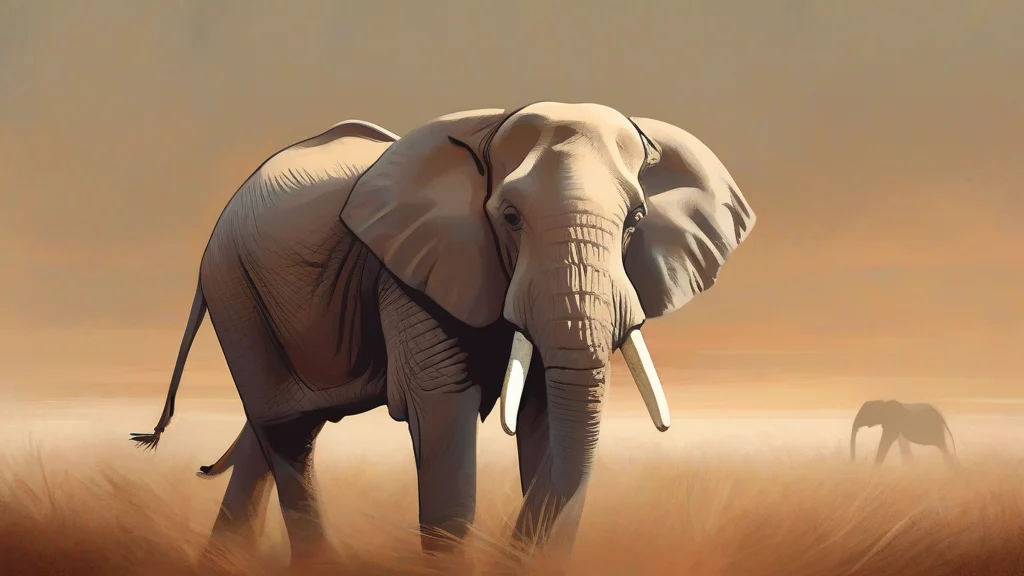
What does elephant mean?
An elephant is the largest living land animal, a massive herbivorous mammal distinguished by its prehensile trunk, elongated ivory tusks, pillar-like legs, and large flapping ears. Two main species are recognized — the African elephant and the Asian elephant — differing in size, ear shape, and range. Elephants are highly social and famously intelligent, living in matriarchal herds and exhibiting behaviors associated with grief, cooperation, and long-term memory, which underpins the English expression 'an elephant never forgets.' Beyond its literal sense, the word carries rich figurative weight: a 'white elephant' is a costly, impractical possession, while 'the elephant in the room' names an obvious problem that everyone pointedly ignores. The word derives ultimately from the Greek 'elephas,' which originally meant 'ivory' — a reminder that for ancient Mediterranean peoples the animal was known chiefly through the prized material its tusks provided.
nounA very large herbivorous mammal of the family Elephantidae, with a long trunk, tusks, and large ears, native to Africa and southern Asia.
- The large mammal of the family Elephantidae, found in African and Asian species, characterized by its trunk, tusks, and large ears.
- (figurative) Something enormous or conspicuously unwieldy, especially in the phrases 'white elephant' (a costly but useless possession) and 'the elephant in the room' (an obvious problem everyone avoids mentioning).
"The herd of elephants crossed the river at dusk, the calves sheltered between the adults."
"Poaching has devastated elephant populations across East Africa over the past century."
"Nobody wanted to mention the budget shortfall — it was the elephant in the room for the entire meeting."
Standard regular plural. The collective noun is 'a herd of elephants'; 'elephants' may also refer collectively to the animals in general, e.g. 'elephants communicate using infrasound.'
"Elephants can recognize themselves in mirrors, a rare sign of self-awareness among animals."
An elephant's trunk contains around 40,000 muscles — and no bones — making it one of the most versatile limbs in the animal kingdom.
Reviewed by Deb Chak, Editor. AI-assisted content curated by RJS Tech Solutions LLP.
Etymology of elephant
The word 'elephant' entered Middle English in the late medieval period from Old French 'olifant,' which derived from Latin 'elephantus,' itself borrowed from the Greek 'elephas' (genitive 'elephantos'). Strikingly, the original Greek word meant 'ivory' rather than the animal, reflecting how the material reached the Greeks through trade before the creature itself was widely known. The Latin form passed into most European languages, giving modern French 'éléphant,' Spanish 'elefante,' Italian 'elefante,' and German 'Elefant.' A related medieval survival is 'oliphant,' used for the ivory war-horns celebrated in the Song of Roland.
Related word forms
How elephant is actually used
In figurative use, 'a white elephant' denotes an expensive burdensome possession, a phrase tracing back to the legend that Siamese kings gave sacred white elephants to courtiers they wished to ruin through upkeep costs. 'The elephant in the room' is common in both formal journalism and casual conversation. The plural is 'elephants'; the collective noun is 'herd' (or, more traditionally, 'memory' in the playful phrase 'a memory of elephants').