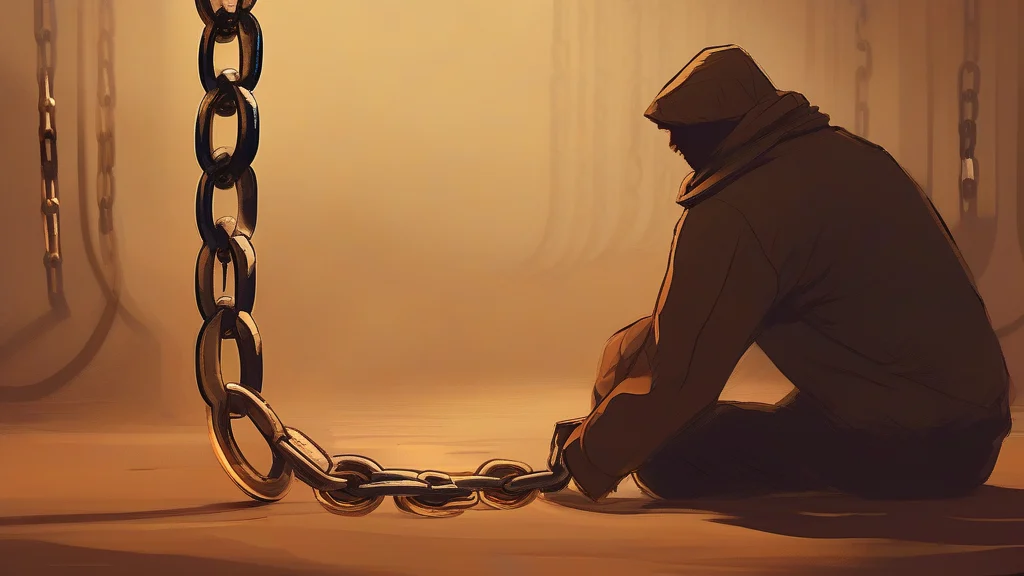
What does enchaining mean?
Enchaining is the present participle of the verb 'to enchain', meaning to bind with chains or, far more commonly today, to restrain something as though with chains. The physical sense — actually fastening a person in fetters — survives chiefly in historical writing about slavery, imprisonment, and captivity. In contemporary use the word is almost entirely figurative: minds are enchained by dogma, hearts by love, imaginations by habit, and societies by tradition. The word carries strong literary connotations and appears most often in formal or elevated prose, where it lends gravity and drama to descriptions of constraint. It derives from the French 'enchâiner', built on the Latin 'catena' meaning chain — the same root that gives us 'concatenate'. Related forms include the verb 'enchain', the adjective 'enchained', and the noun 'enchainment'. Because it vividly personifies restraint, enchaining remains a powerful choice for writers who want to evoke bondage that is psychological or spiritual rather than literal.
verb (present participle and gerund of 'enchain')Enchaining is the act of fastening or binding someone or something with chains, or figuratively restraining, holding captive, or making something dependent as if with chains.
- To bind or fasten with chains; to shackle physically.
- To restrain or hold captive in a figurative sense — as by passion, habit, fear, or obligation.
"The novel depicts a mind enchained by superstition, unable to embrace reason."
"The captives were enchained in the hold of the ship for the entire voyage."
"He wrote of an imagination enchained by convention, longing for freer forms of expression."
'Enchaining' shares its root with 'concatenate' — every time you link files together, you're quietly using the Latin word for chain.
Reviewed by Deb Chak, Editor. AI-assisted content curated by RJS Tech Solutions LLP.
Etymology of enchaining
Enchaining comes from the English verb 'enchain', borrowed from the Old French 'enchâiner' or 'enchainer', formed from the prefix 'en-' plus 'chaine' (chain), which itself derives from the Latin 'catena', meaning chain. English adopted 'enchain' around the late sixteenth century, and both its literal and figurative senses have been attested since that period. The Latin root 'catena' also underlies 'concatenate' (literally 'to chain together') and the mathematical term 'catenary', making these true cognates of enchaining.
Related word forms
How enchaining is actually used
Literary and somewhat formal in register; the physical sense of literal shackling is now rare, and modern usage is predominantly figurative, often appearing in elevated prose about mental, emotional, or social bondage.
Easily confused with enchaining
Unchaining means releasing from chains or bonds — the exact opposite action to enchaining, which means binding or restraining.
Entraining means boarding a train or drawing something along in a flow, whereas enchaining means binding with chains.