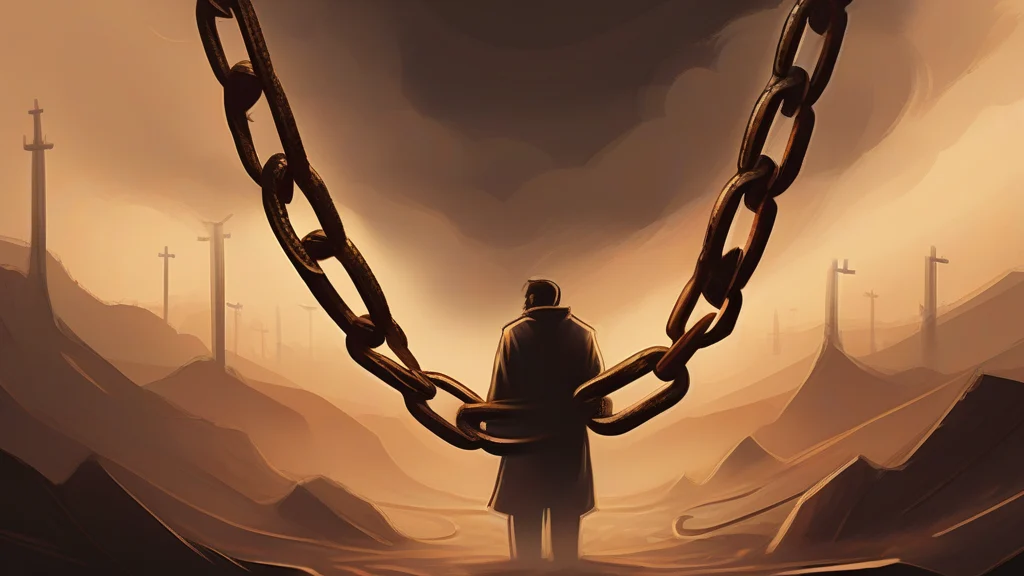
What does enchained mean?
Enchained is chiefly the past form of the verb "enchain," meaning to bind someone or something with chains, and by extension it functions adjectivally to describe anything held fast by real or metaphorical bonds. Its literal use evokes prisoners, slaves, or animals in restraint, but today it most often appears in elevated or literary prose describing people held captive by intangible forces — fear, grief, dogma, poverty, or habit. A writer might describe a mind "enchained by superstition" or a nation "enchained to its past." The word carries strong connotations of oppression and loss of freedom, giving it a weightier, more dramatic tone than plain "chained" or "tied." It derives from the prefix "en-" plus "chain," ultimately rooted in the Latin "catena." Because it vividly fuses physical imagery with abstract constraint, it remains a powerful choice for rhetoric and literary description.
Simple past tense and past participle of enchain: to bind with or as if with chains.
"They enchained the captives before the long march inland."
Bound with or as if with chains; held captive or constrained.
"She wrote of a generation enchained by debt."
From the same Latin root that gives us "catenary," the curve a hanging chain traces — "enchained" literally carries the shape of captivity inside it.
Reviewed by Deb Chak, Editor. AI-assisted content curated by RJS Tech Solutions LLP.
Etymology of enchained
Enchained comes from the verb "enchain," formed from the French-style prefix "en-" plus "chain," which entered English from Old French "chaeine," ultimately from Latin "catena" meaning chain. The compound verb appeared in English around the late sixteenth century, used both literally for binding with chains and figuratively for moral or intellectual bondage. The same Latin root gives us "catenary," the mathematical term for the curve formed by a hanging chain.
Related word forms
How enchained is actually used
Predominantly literary and formal in register; the figurative sense is more common than the literal in modern usage. The verb form is "enchain."
Easily confused with enchained
"Unchained" means released from chains or constraints, while "enchained" means the opposite — bound by or as if by chains.