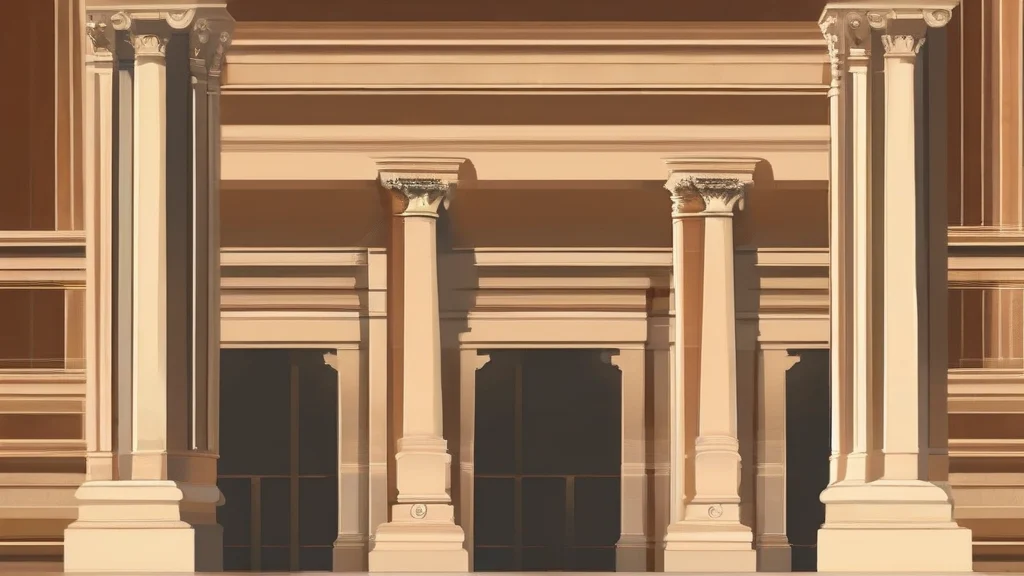
What does entablature mean?
An entablature is the horizontal structure that rests on top of a row of columns in classical architecture. It consists of three main parts: the architrave (the lowest band directly on the columns), the frieze (the middle band, often decorated with sculpture), and the cornice (the projecting uppermost molding). The term comes from the Italian "intavolatura," literally something laid out like a table, reflecting its flat, table-like form. Entablatures are central to the classical orders—Doric, Ionic, and Corinthian—each with distinctive proportions and ornamentation. Beyond ancient Greek and Roman temples, the concept persists in Renaissance, Neoclassical, and modern buildings that echo classical design. For anyone studying architecture or art history, understanding the entablature is essential to describing how a colonnade carries and crowns a building's upper structure.
nounIn classical architecture, the horizontal superstructure resting on a colonnade, comprising the architrave, frieze, and cornice.
- The horizontal arrangement of architrave, frieze, and cornice that rests upon columns in classical architecture.
"The temple's entablature was carved with reliefs honoring the goddess Athena."
"Restorers carefully reinforced the crumbling entablature of the ancient portico."
"In Doric order the entablature is comparatively plain, whereas the Ionic version often features a continuous sculpted frieze."
Standard pluralization applies; used when discussing multiple buildings or orders.
"The survey catalogued dozens of surviving Roman entablatures across the region."
Every Greek temple you've ever seen in a photo owes its iconic look to three stacked bands of stone called the entablature — the 'little table' sitting atop the columns.
Reviewed by Deb Chak, Editor. AI-assisted content curated by RJS Tech Solutions LLP.
Etymology of entablature
The word "entablature" derives from the Italian "intavolatura," from "tavola" meaning "table," ultimately rooted in the Latin "tabula" (a board or tablet). It entered English in the early 17th century, likely by way of French architectural treatises. It shares this Latin root with words such as "table," "tablet," and "tabular."
How entablature is actually used
A technical term used almost exclusively in architectural history, archaeology, and classical studies; rare in everyday speech. Its meaning is specific to the classical orders (Doric, Ionic, Corinthian) and their derivatives.
Easily confused with entablature
"Tablature" is a system of musical notation for stringed instruments, while "entablature" is the architectural element above columns.