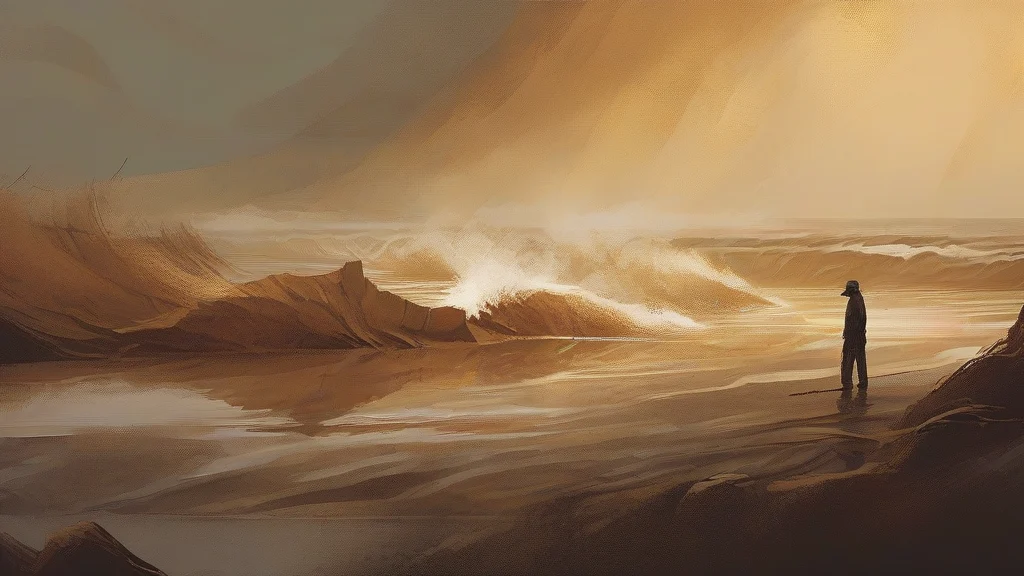
What does eroded mean?
'Eroded' is the past tense and past participle of the verb 'erode', describing something that has been gradually worn away by natural forces such as flowing water, wind, waves, or glacial ice. A beach may be eroded by storms, a cliff face eroded by the sea, and topsoil eroded by rain. The word also has an important figurative use: abstract things can be eroded just as surely as rock, so we speak of eroding trust, eroded civil liberties, or profit margins that have been eroded by rising costs. In every case the essential idea is slow, persistent loss — erosion happens bit by bit, usually without dramatic suddenness, which gives the word a quiet but ominous connotation. It appears constantly in geology, environmental science, economics, and political commentary, making it a versatile and precise choice whenever gradual diminishment needs to be described.
Past form indicating that something was worn away gradually by natural agents, or figuratively that it was slowly diminished or destroyed.
"Wind and rain have eroded the ancient carvings until they are barely legible."
Describing something that has been worn away or reduced gradually, especially by natural forces.
"They hiked along a rugged, eroded trail high above the valley floor."
Frequently modified by degree adverbs: 'badly eroded', 'severely eroded', 'slightly eroded'.
The same ancient root that gave us 'eroded' gave us 'rodent' — because both literally mean 'to gnaw away'.
Reviewed by Deb Chak, Editor. AI-assisted content curated by RJS Tech Solutions LLP.
Etymology of eroded
'Eroded' derives from the verb 'erode', which English adopted from Latin 'erodere', meaning 'to gnaw out or eat away', formed from 'e-' (out of) plus 'rodere' (to gnaw). The same vivid root 'rodere' produced 'rodent' — creatures named for their gnawing habit — as well as 'corrode' and 'corrosion'. The verb entered English in the early seventeenth century, initially used broadly for any gnawing or eating away, before settling into its modern emphasis on gradual wearing away by natural forces.
Related word forms
How eroded is actually used
As a participial adjective, 'eroded' is common in geological, environmental, and scientific writing, but its figurative use with abstract subjects (trust, morale, margins, rights) is equally frequent in journalism and everyday speech. It carries a neutral to slightly negative connotation, implying slow, often unnoticed loss.
Easily confused with eroded
'Corroded' refers specifically to destruction by chemical action such as rust on metal, while 'eroded' refers to gradual wearing away typically by natural forces like water, wind, or ice.