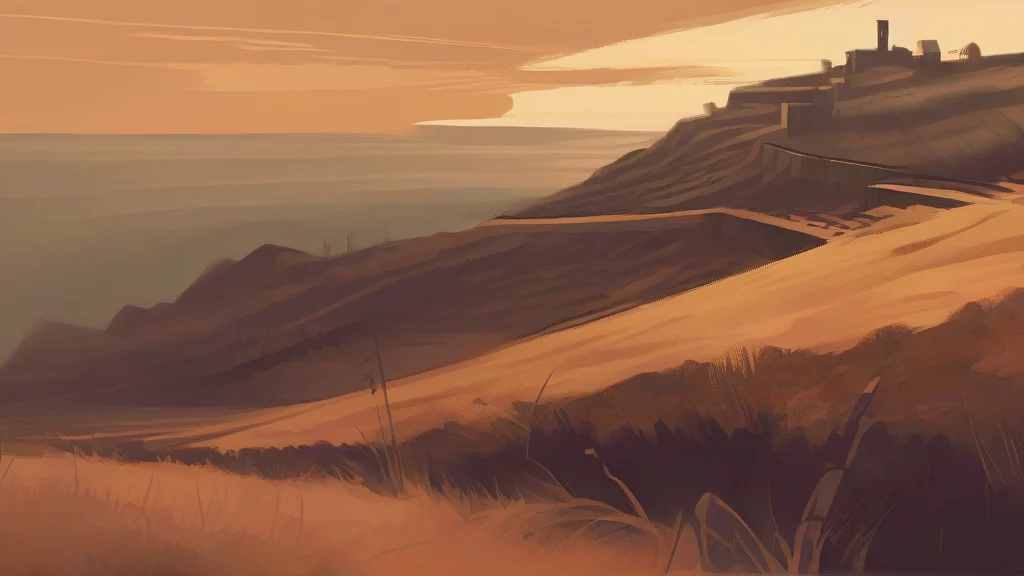
What does escarp mean?
An escarp is a steep slope or bank, most precisely the inner face of the broad ditch that once surrounded a fortress. In classical fortification design, attackers who crossed the ditch had to scale this near-vertical wall under fire, which made the escarp one of the most critical features of a bastion's defenses. Engineers typically strengthened it with masonry or revetments so that it would resist both erosion and artillery. The term derives from the Italian scarpa, meaning shoe or slope, the same root behind the everyday words scarp and the geographical escarpment, which denotes long cliffs such as those bounding plateaus and mountain ranges. Outside specialist military writing, escarp survives chiefly in historical accounts of siege warfare and in older descriptions of terrain, having largely yielded its general sense to its more familiar descendant, escarpment. Knowing the word offers a window into the precise vocabulary engineers once used to describe ground shaped for defense.
nounA steep slope or face, especially the inner side of a ditch surrounding a fortification, or more generally the steep side of a hill or ridge.
- The steep inner slope or face of the ditch surrounding a fortified place.
- More generally, any steep slope or cliff-like face of ground.
"The defenders lined the escarp with artillery to sweep the approach across the moat."
"Engineers revetted the escarp so that the earthen face would not collapse under bombardment."
"The path climbed abruptly along the escarp before leveling onto the plateau."
Standard regular plural; used when referring to multiple slopes or the escarps of several fortifications.
"The survey recorded the crumbling escarps of three hill forts along the ridge."
The same Italian word for 'shoe' gave English both 'escarp' — a fortress's deadly inner wall — and, via 'scarpa', the very idea of a shoe's shape.
Reviewed by Deb Chak, Editor. AI-assisted content curated by RJS Tech Solutions LLP.
Etymology of escarp
Escarp entered English in the seventeenth century by way of French escarpe, ultimately from the Italian scarpa, which originally meant 'shoe' and came to denote a sloped embankment. The same root produced scarp, the shorter English form, and escarpment, which extended the military sense to large natural landforms. Its counterpart in fortress architecture, the counterscarp, names the opposite outer slope of the ditch.
How escarp is actually used
Primarily a technical term of military engineering and fortification, where it is paired with its counterpart the counterscarp (the outer slope of the ditch). In general use it appears mostly as the shortened form 'scarp' or in the derived noun 'escarpment', so plain 'escarp' can sound specialized or archaic outside military contexts.
Easily confused with escarp
An escarpment is a long, extensive cliff or steep slope formed by erosion, while an escarp is specifically the steep inner face of a defensive ditch in fortification, though the two words share the same root.
Escape is a verb and noun meaning to break free from confinement, whereas an escarp is a steep slope; the similarity is purely visual and phonetic.