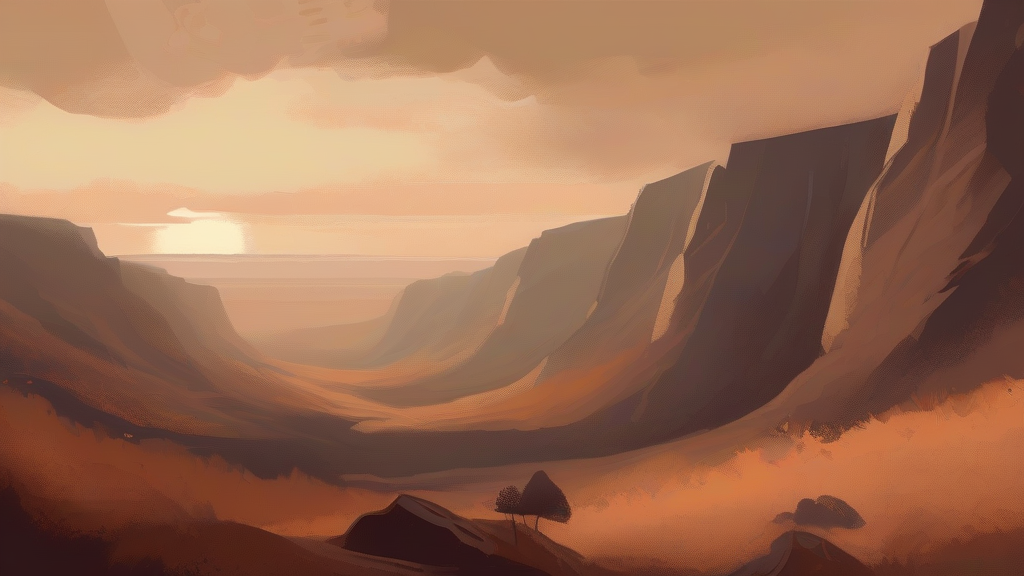
What does escarpment mean?
An escarpment is a long, steep slope or cliff that separates two relatively flat areas of land at different heights. In geology, it typically forms where a layer of hard, resistant rock sits atop softer rock: erosion wears the soft layer away faster, leaving the hard layer jutting out above a pronounced slope. Famous examples include the Niagara Escarpment in North America and the chalk escarpments of southern England, such as the North and South Downs. The word belongs chiefly to the vocabulary of geography, geology, and landscape description, though it appears regularly in travel writing thanks to the dramatic scenery such features create. It is a precise, neutral term — an escarpment is not just any cliff or hillside, but an elongated erosional feature marking the edge of an upland or plateau. Knowing the word allows a writer to describe these striking landforms accurately and evocatively in a single term.
nounA long, steep slope or cliff that separates two relatively level areas of land, typically formed by erosion of tilted or uplifted rock strata.
- A long steep slope or cliff separating two level areas of land, formed by differential erosion, especially where resistant rock overlies softer rock.
"The village clung to the edge of the escarpment, its houses overlooking a vast plain far below."
"Hikers followed the trail along the escarpment, pausing to take in the sweeping view of the valley below."
"The chalk escarpment of the South Downs rises abruptly from the Weald, marking one of southern England's most distinctive landscapes."
Standard regular plural; used when referring to multiple such landforms or to escarpments in different regions.
"The region's escarpments were carved by glaciers during the last ice age."
The Niagara Escarpment is so ancient that it predates the dinosaurs — and Niagara Falls has been slowly carving its way back along it for over 12,000 years.
Reviewed by Deb Chak, Editor. AI-assisted content curated by RJS Tech Solutions LLP.
Etymology of escarpment
Escarpment comes from French 'escarpement', derived from the verb 'escarper' ('to make steep'), which traces back through Old North French and Italian 'scarpare' to Italian 'scarpa', meaning 'shoe' or 'slope'. The same root gave English the shorter form 'scarp' and the related military term 'escarp'. The word entered English in the early 19th century, borrowed directly from French scientific writing on landforms.
How escarpment is actually used
Escarpment is primarily a technical term in geology and physical geography but is widely used in travel writing and descriptive prose. It carries no emotional connotation — it is neutral and descriptive. The word applies specifically to elongated slopes or cliffs produced by erosion of rock layers, not to small banks or ordinary hillsides.
Easily confused with escarpment
Scarp is essentially the same landform and often interchangeable, but 'escarpment' is the fuller, more formal term; 'scarp' can also mean the inner wall of a fortification trench.
A plateau is the flat elevated upland itself, whereas an escarpment is the steep slope at its edge.