What does everglade mean?
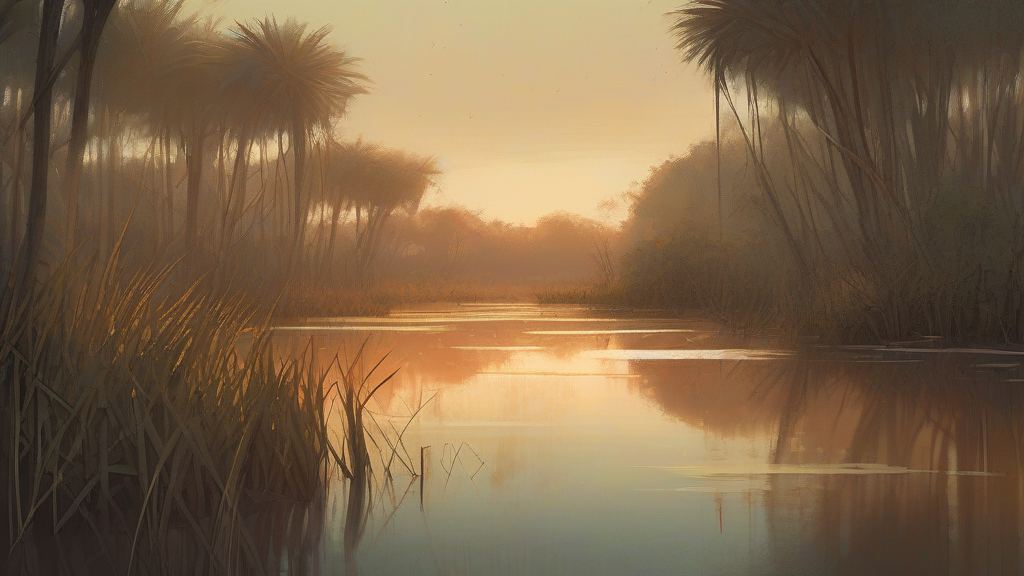
An everglade is a tract of low-lying, marshy ground covered largely with coarse grasses and dotted with clumps of trees — essentially an open wetland that is neither deep swamp nor dry meadow. The word is formed transparently from "ever" and "glade," suggesting a marshy opening that seems to go on without end. In contemporary English it appears only rarely as a common noun; nearly all everyday uses refer to the Everglades, the enormous subtropical wetland ecosystem of southern Florida, which is always written as a capitalized plural proper noun. Used generically, the word has a descriptive, slightly literary flavor, evoking landscapes of saw grass, shallow water, and wading birds. It is a useful word precisely because of this specificity: where "swamp" suggests dense woodland and "marsh" suggests reeds, an everglade conveys a broad, grassy expanse of seasonally flooded country.
nounA tract of marshy or swampy ground, especially one overgrown with coarse grasses and interspersed with clumps of trees.
- A stretch of low, marshy ground overgrown with tall grasses and scattered trees.
"The trail wound through the everglade, the boardwalk rising just above the still, grass-choked water."
"Herons stalked the edges of the everglade as the morning mist lifted off the water."
"The old survey map marked the everglade as impassable terrain, best avoided by travelers on foot."
Note that when capitalized and always plural, "the Everglades" refers specifically to the wetland region of southern Florida and takes plural agreement.
"Several everglades stretched across the coastal plain before development drained them."
The word is older than you might think: English speakers were writing about everglades long before Florida's famous swamp gave the word its fame.
Reviewed by Deb Chak, Editor. AI-assisted content curated by RJS Tech Solutions LLP.
Etymology of everglade
Everglade is an English compound formed from the adverb "ever" plus the noun "glade," meaning an open space in a forest — here extended to open, grassy marshland. The compound arose in English usage to describe seemingly endless tracts of such terrain, and it became widely known through its application to southern Florida's great wetland, officially designated the Everglades in the nineteenth century. Beyond these clear English components, no deeper etymological lineage can be stated with confidence.
Related word forms
How everglade is actually used
The word is rare outside its capitalized proper-name use; most modern readers encounter it almost exclusively through references to the Florida Everglades. When used generically it carries a literary or descriptive register rather than a technical one.
Easily confused with everglade
"Everglades" (always plural, capitalized) is the proper name of the vast subtropical wetland region in southern Florida, while "everglade" in lowercase is the generic common noun for any marshy, grassy tract.