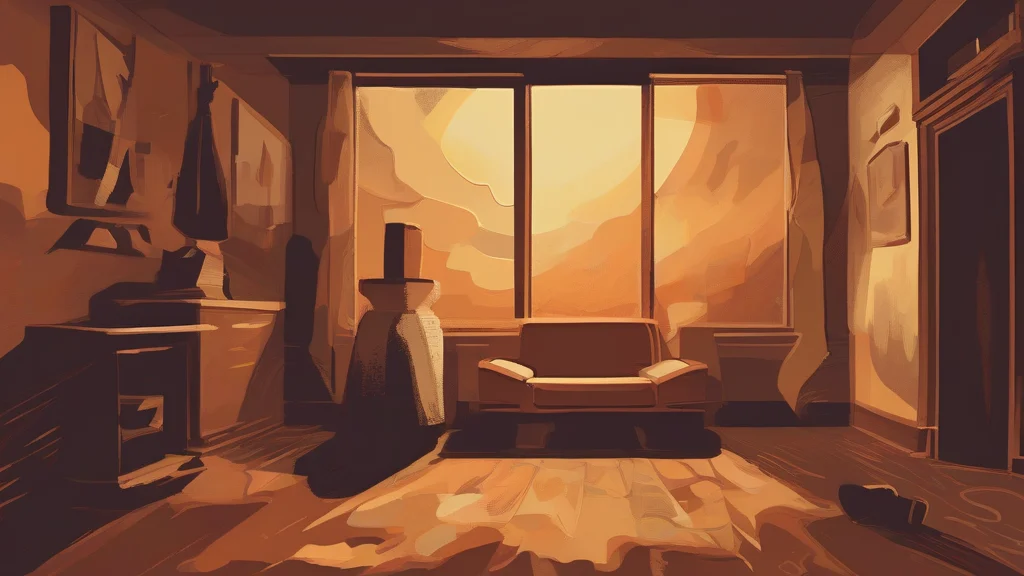
What does expressionistic mean?
Expressionistic is an adjective used to describe art, films, writing, music, or performances that prioritize emotional intensity over faithful representation of the visible world. It derives from Expressionism, the early twentieth-century movement — strongest in Germany and Austria — whose practitioners distorted color, form, and perspective to externalize inner states such as anxiety, ecstasy, or alienation. Calling a painting expressionistic suggests bold colors and exaggerated shapes; calling a film expressionistic evokes the shadowy, angular sets of German classics like The Cabinet of Dr. Caligari. Beyond the historical movement, the word is applied more loosely to anything marked by deliberate distortion or heightened subjectivity in service of feeling. Its antonyms are words like realistic or naturalistic. Because it names both a specific artistic tradition and a broader stylistic tendency, expressionistic is a useful term for discussing how artists bend reality to communicate emotion.
adjectiveRelating to or characteristic of Expressionism, the artistic movement that seeks to convey emotional experience rather than physical reality. More generally, depicting things in a deliberately distorted, intense, or subjective way to evoke strong feeling.
- Of or relating to Expressionism, the early 20th-century movement in art, film, theatre, and literature that prioritizes emotional experience over realistic depiction.
- (More generally) Marked by distortion, exaggeration, or intense subjectivity in order to express inner feeling rather than objective reality.
"The film's expressionistic sets, with their skewed angles and looming shadows, mirrored the protagonist's unraveling mind."
"Kirchner's expressionistic canvases use jagged lines and clashing colors to convey urban anxiety."
"The director favored an expressionistic staging: bare walls, harsh lighting, and actors frozen mid-scream."
Expressionist painters didn't want you to see a face — they wanted you to feel one, which is why 'expressionistic' describes art that distorts reality on purpose.
Reviewed by Deb Chak, Editor. AI-assisted content curated by RJS Tech Solutions LLP.
Etymology of expressionistic
Expressionistic comes from Expressionism, the name of the early twentieth-century artistic movement, formed on 'expression' with the suffix '-ism'. 'Expression' itself traces back through French and Latin 'exprimere', meaning 'to press out', from 'ex-' ('out') and 'premere' ('to press'). The adjective is built with the '-istic' suffix, giving English speakers a way to describe works in the Expressionist manner; related forms include 'expressionism' and 'expressionist'.
Related word forms
How expressionistic is actually used
The word is most often applied to visual art, film (especially German cinema of the 1920s), theatre, and literature. It carries no negative connotation, though it implies a departure from realism. When capitalized ('Expressionistic' alongside 'Expressionism'), it refers specifically to the historical movement; lowercase use covers any emotionally driven, non-naturalistic style.
Easily confused with expressionistic
Impressionistic refers to the Impressionist movement and its focus on fleeting light and surface appearance, while expressionistic refers to Expressionism's focus on inner emotional states, often through distortion.