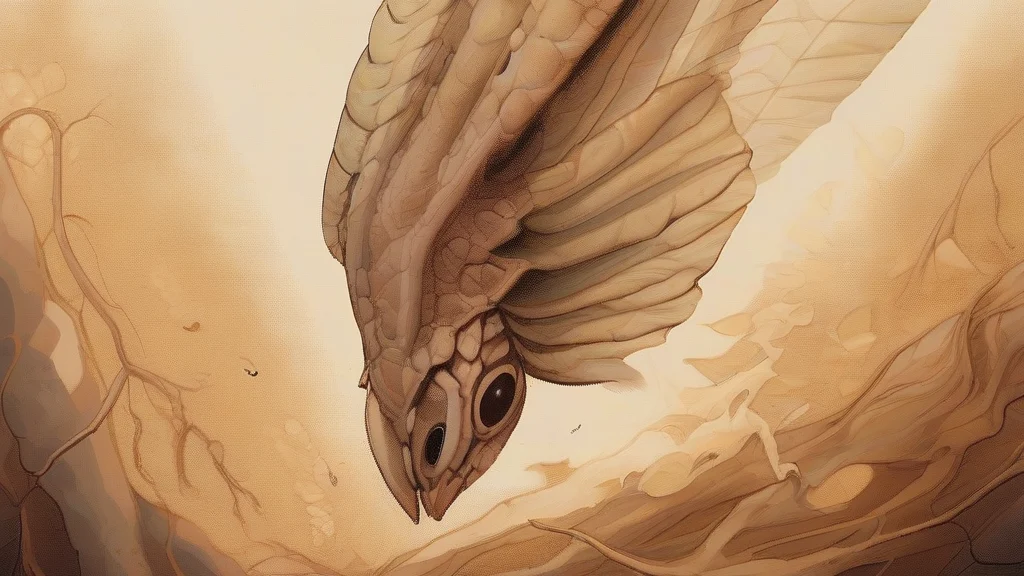
What does exuviae mean?
Exuviae refers to the skins, shells, or other outer coverings that animals shed as they grow — most familiarly the papery husks left behind by cicadas, mayflies, dragonflies, and other moulting creatures, but also the sloughed skins of snakes and the discarded shells of crustaceans. The word derives from Latin exuviae, meaning "things stripped off," from the verb exuere, "to strip or divest oneself of." Though rooted in classical language, exuviae survives today almost entirely in technical and scientific registers, particularly entomology, where identifying species from larval exuviae is standard practice because the cast skins preserve detailed anatomical features. It can also be used more broadly, if somewhat literary, to describe the remains or relics of anything abandoned. Because the term carries no emotional charge and is unfamiliar to most general readers, writers typically reserve it for contexts where precision matters, preferring plainer words like "shed skin" elsewhere.
nounThe cast-off skins, shells, or outer coverings shed by animals such as insects, crustaceans, and snakes during moulting. In broader use, any remains or discarded remnants of something that has been left behind.
- The cast-off skins, shells, or outer coverings shed by arthropods, reptiles, and other animals during ecdysis (moulting).
- Figuratively or in literary/technical use: remains, relics, or discarded remnants of anything.
"Along the riverbank, the exuviae of mayflies clung to the reeds like translucent ghosts."
"The pond's edge was littered with the exuviae of dragonfly nymphs, each one a perfect hollow replica of the insect it once housed."
"Naturalists often collect larval exuviae to identify species without disturbing living specimens."
"Exuviae" is a Latin plural; the singular "exuvia" exists but is less commonly encountered, with "exuviae" frequently functioning as a collective mass noun in technical prose.
"Each exuvia found in the stream suggested a recently emerged adult nearby."
Every cicada you've ever seen clinging to a tree trunk is an empty suit — the exuviae of an insect that flew off and left its old self behind, still gripping bark with tiny claws.
Reviewed by Deb Chak, Editor. AI-assisted content curated by RJS Tech Solutions LLP.
Etymology of exuviae
Exuviae comes directly from the Latin plural exuviae, meaning "clothes or armour stripped off," derived from the verb exuere, "to strip off, to divest." The word entered English in the early modern period, initially carrying both literal and figurative senses before settling into predominantly technical usage in natural history. Its cognates include the English verbs exuviate and exuviation, which describe the act of shedding, and the adjective exuvial, used in describing structures related to cast-off coverings.
Related word forms
How exuviae is actually used
"Exuviae" is a Latin plural form; in scientific writing it is often treated as plural ("the exuviae were found...") but sometimes as a singular mass noun. The register is formal and technical, appearing chiefly in entomology, zoology, and palaeontology rather than everyday conversation.
Easily confused with exuviae
'Exuvia' is the singular form referring to a single cast-off covering, while 'exuviae' is the plural (or a Latin plural used as a collective) referring to multiple such coverings or the shed material collectively.