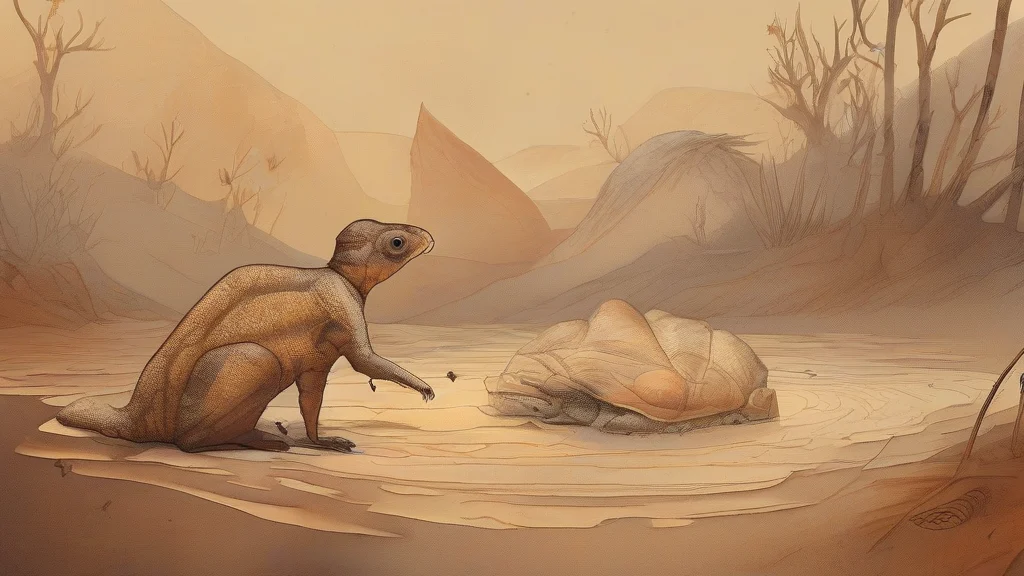
What does exuviate mean?
Exuviate is a formal verb meaning to shed or cast off the skin, shell, or other outer covering — the process biologists more commonly call molting. It is used chiefly of arthropods such as insects, crustaceans, and spiders, whose rigid exoskeletons must be discarded periodically in order for the animal to grow, though it can apply to reptiles shedding skin as well. The word derives from the Latin exuviae, meaning the skin or clothing stripped off, itself from exuere, 'to strip off'. Because of its technical flavor, exuviate appears almost exclusively in zoology, entomology, and scholarly prose rather than everyday speech, where speakers prefer molt or shed. Its precise, classical pedigree makes it useful when writing about animal growth with scientific exactness, and it lends any description of transformation a vivid image of stepping out of an old casing into something new.
verbTo shed or cast off the skin, shell, or outer covering; to molt. Used chiefly in zoology and entomology to describe an animal discarding its exoskeleton or integument.
- To shed or cast off the skin, exoskeleton, or outer covering (of an animal); to molt.
"Cicadas exuviate once their nymphal skins split along the back."
"The tarantula exuviates several times before reaching full size."
"Each summer the crayfish exuviate, leaving translucent shells on the streambed."
When a snake or cicada exuviates, it literally steps out of its old self — the word comes from Latin for clothes stripped off.
Reviewed by Deb Chak, Editor. AI-assisted content curated by RJS Tech Solutions LLP.
Etymology of exuviate
Exuviate comes from the Latin exuviae, meaning clothing or skin that has been stripped off, derived from the verb exuere, 'to strip off, doff', formed from the prefix ex- ('out of') and the root of vestis-related stripping senses. English adopted it as a learned scientific term, likely in the 17th century alongside the noun exuviae, which naturalists use for the cast-off skins and shells of animals. Its cognates are few but direct: exuviae and the adjective exuvial share the same Latin source, while the broader root connects distantly to words for garments and removal in Romance languages descended from exuere's family.
How exuviate is actually used
A formal, technical term found mainly in zoological, entomological, and scientific writing; ordinary English favors 'molt', 'shed', or 'slough'. It is typically used intransitively ('the insect exuviates') but can take an object ('the insect exuviates its cuticle'). The corresponding noun for what is shed is 'exuviae'.
Easily confused with exuviate
'Evacuate' means to empty out or withdraw people from a place, while 'exuviate' means specifically to shed skin or an outer covering.