
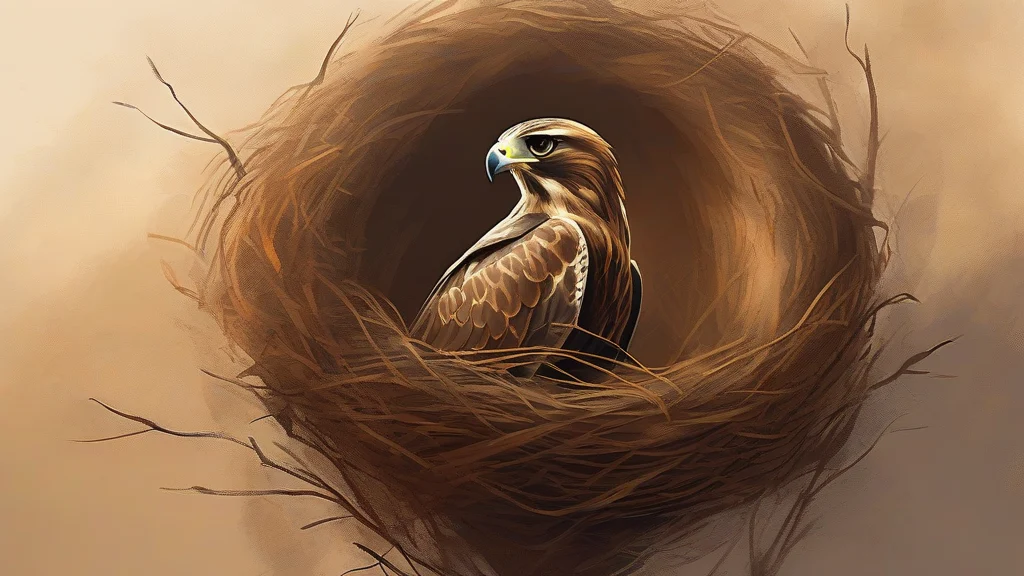
What does eyas mean?
An eyas is a young hawk or other bird of prey that has not yet left the nest — in other words, a nestling raptor. The word belongs chiefly to the specialised vocabulary of falconry, where it distinguishes a chick taken from the nest for hand-rearing and training from birds acquired at later stages of development. Because eyas refers to a bird still dependent on parental care, it carries connotations of youth, vulnerability, and untapped potential, which has allowed writers occasionally to use it figuratively for an inexperienced person being groomed for a demanding role. The term entered English in the fifteenth century through an intriguing accident: it derives from the Old French niais, meaning a nestling (ultimately from Latin nidus, 'nest'), and Middle English speakers misheard 'a nyas' as 'an eyas', shedding the initial 'n'. Its plural is eyases. Though uncommon outside specialist circles, eyas remains a precise and evocative term wherever birds of prey are bred, trained, or studied.
nounA young hawk or other bird of prey that is still in the nest and has not yet fledged; more broadly, a nestling bird taken for training in falconry.
- A nestling hawk or bird of prey, especially one taken from the nest for training in falconry.
"The falconer carefully fed the eyas by hand until it was strong enough to begin training."
"The raptor centre raised each eyas on a diet of fresh quail."
"Taking an eyas from the wild is now strictly regulated in most countries."
The standard plural adds -es; the singular-sounding 'eyas' is never used as a plural form.
"The breeding programme produced three eyases this spring."
An eyas isn't just any baby bird — it's the word falconers use for a hawk chick taken from the nest to be trained, and its odd history involves a centuries-old mistake: English speakers heard 'a nyas' and chopped off the 'n'.
Reviewed by Deb Chak, Editor. AI-assisted content curated by RJS Tech Solutions LLP.
Etymology of eyas
Eyas comes from Old French niais, meaning 'nestling', ultimately from Latin nidus ('nest'), the same root behind ornithological terms such as nidification. It was borrowed into Middle English as nyas, and the modern form arose through metanalysis: speakers misparsed 'a nyas' as 'an eyas', dropping the 'n' — the same process that turned 'a napron' into 'an apron'. The word has been in English since at least the fifteenth century and has always referred to a nestling bird of prey, particularly in falconry contexts.
Related word forms
How eyas is actually used
Eyas is a technical term used mainly in falconry and ornithology; it is rare in everyday speech. It specifically denotes a chick still in the nest, before it has fledged.
Easily confused with eyas
An easement is a legal right to use another's land, while an eyas is a nestling hawk — the two share no meaning despite superficial spelling resemblance.
An aye-aye is a Madagascan lemur; an eyas is a nestling bird of prey — similar sounds but entirely unrelated.