
What does faerie mean?
Faerie is a literary and archaic English noun denoting the realm of the fairies — fairyland, an enchanted otherworld — and, less commonly, an individual fairy. It derives from Old French faerie, meaning enchantment, ultimately rooted in the Latin Fata, the personified Fates who were believed to govern human destiny. Today the word survives chiefly in fantasy literature, poetry, and discussions of folklore, where writers choose it over the everyday "fairy" precisely because of its antique flavor and its association with the whole supernatural domain rather than a single winged sprite. Its most celebrated appearance is in Edmund Spenser's Elizabethan epic The Faerie Queene, an allegorical poem set in a fantastical kingdom. Because "faerie" signals deliberate archaism, using it in casual speech can sound affected; it belongs naturally in storytelling, scholarship on Celtic and European folklore, and imaginative fiction that draws on older mythic traditions.
The realm or world of the fairies; fairyland.
"Legends claim that anyone who eats food in the faerie can never fully return to the mortal world."
Often capitalized when referring to the realm as a proper name.
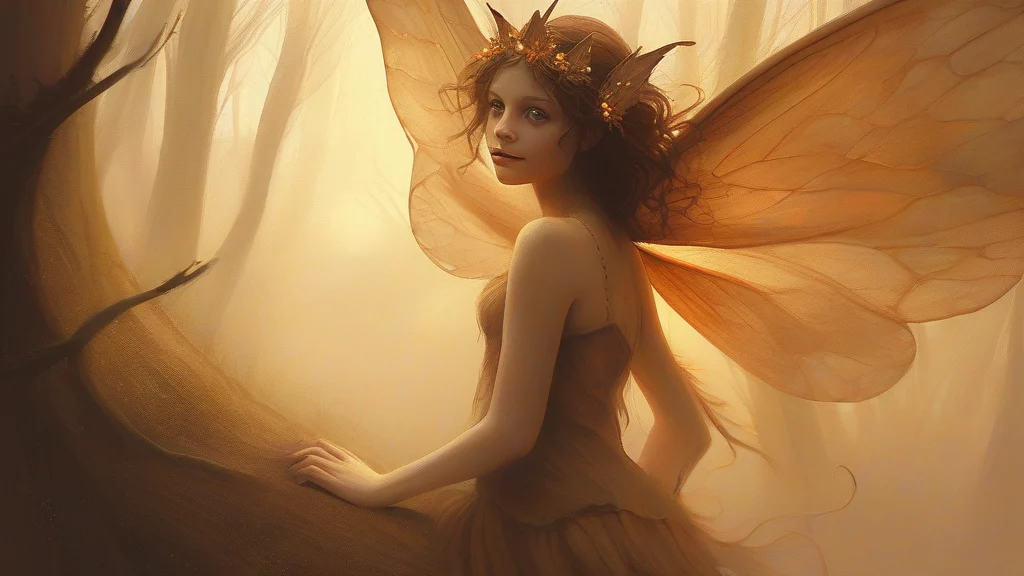
(Archaic or literary) An individual fairy.
"A faerie appeared at the edge of the wood, shimmering like moonlight on water."
This sense is now rare; "fairy" is the standard modern term.
The plural is regular, formed by adding -s. It applies mainly to the sense of individual fairies, since the realm sense is typically uncountable.
"The meadow was said to dance with faeries on midsummer nights."
Edmund Spenser's epic poem The Faerie Queene gave this word its most famous showcase — but it's really just Middle English for 'enchantment.'
Reviewed by Deb Chak, Editor. AI-assisted content curated by RJS Tech Solutions LLP.
Etymology of faerie
Faerie entered Middle English from Old French faerie, which meant "enchantment" or the land of enchanted beings, derived from fae, a fairy, itself from the Latin Fata, the goddesses of fate. The word thus carries the same root as "fate" and "fatal," reflecting the medieval belief that fairies wielded destiny-shaping power. In English it was eventually eclipsed by the shortened form "fairy," leaving "faerie" as a consciously archaic variant favored by poets and fantasists.
How faerie is actually used
"Faerie" is deliberately archaic and literary, used to evoke older folklore traditions or high fantasy register; in ordinary modern English, "fairy" is standard. When capitalized (as in Spenser), it often refers to a specific imagined realm.
Easily confused with faerie
"Fairy" is the standard modern word for a magical creature, while "faerie" is a literary or archaic spelling that usually denotes the fairy realm as a whole rather than an individual being.
"Faery" is simply a variant spelling of "faerie" with the same meaning; neither is the everyday spelling, which is "fairy."