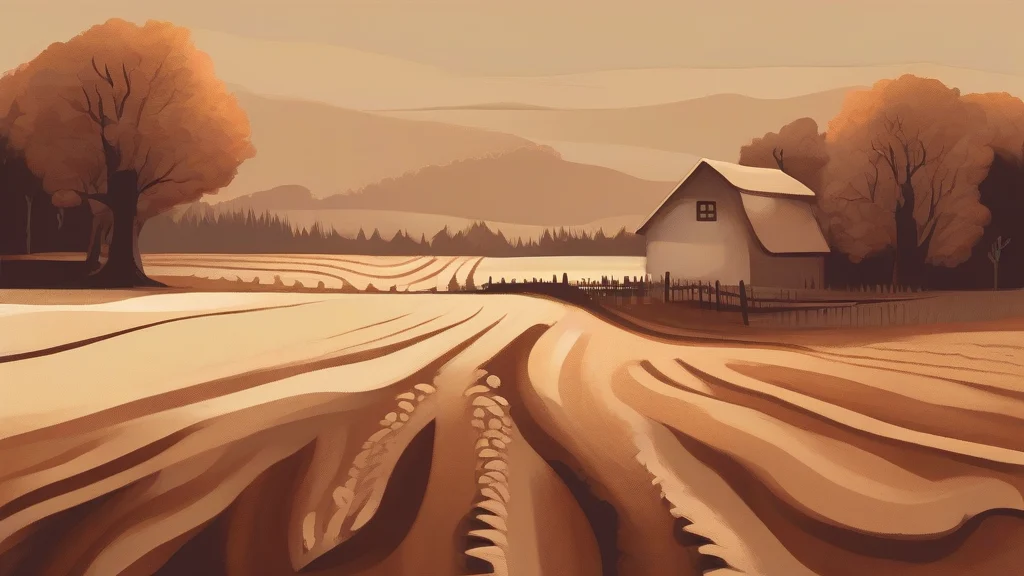
What does fallowed mean?
Fallowed describes land that has been plowed but deliberately left unsown for a season so that it can recover its fertility, and by extension anything that has been intentionally left idle to rest and renew itself. In agriculture, fallowing is an ancient and deliberate practice: by withdrawing a field from cultivation, farmers allow depleted nutrients to accumulate and moisture to build, preparing the soil for stronger future harvests. The word therefore implies purpose rather than neglect — a fallowed field is not abandoned but strategically paused. Figuratively, writers and speakers apply 'fallowed' to minds, careers, and creative capacities that lie dormant between periods of intense activity, often with a positive suggestion of quiet restoration. Related terms include 'fallow' (the base adjective and verb), 'fallowing' (the process), and 'fallowness' (the state). Anyone interested in farming, sustainability, or metaphorical language will find 'fallowed' a precise and evocative word.
To have plowed or tilled land without sowing it, leaving it to rest and regain fertility.
"They fallowed half their holdings during the drought years."
Standardly used of arable farmland; figurative uses treat minds, markets, or creative output as if they were fields.
(Of land) plowed and left unsown; left idle or unused.
"The fallowed terraces stretched silent across the valley."
Usually appears attributively before a noun ('fallowed fields').
Farmers have known for millennia what modern agronomy confirms: sometimes the best thing you can do for a field is nothing at all.
Reviewed by Deb Chak, Editor. AI-assisted content curated by RJS Tech Solutions LLP.
Etymology of fallowed
'Fallow' traces back to Old English 'fealh,' meaning plowed land, belonging to a family of Germanic words (compare Old High German 'falga') that denote tilled but unsown ground. The underlying Germanic root may be connected to an adjective meaning 'pale' or 'yellowish-brown' — the color of bare, weathered earth — which also survives in 'fallow' as a color term describing a pale reddish-yellow, as in a fallow deer's coat. The word is firmly native English, with its agricultural sense attested since the earliest written records of the language.
Related word forms
How fallowed is actually used
'Fallowed' is primarily an agricultural term used literally of farmland, though it appears in extended figurative use describing anything deliberately rested — a writer's imagination, a business venture, a career. It carries neutral-to-positive connotations of intentional renewal rather than abandonment.
Easily confused with fallowed
'Fallowed' refers to leaving land uncultivated to recover, while 'followed' means coming after or going behind someone or something — the words look and sound deceptively similar.