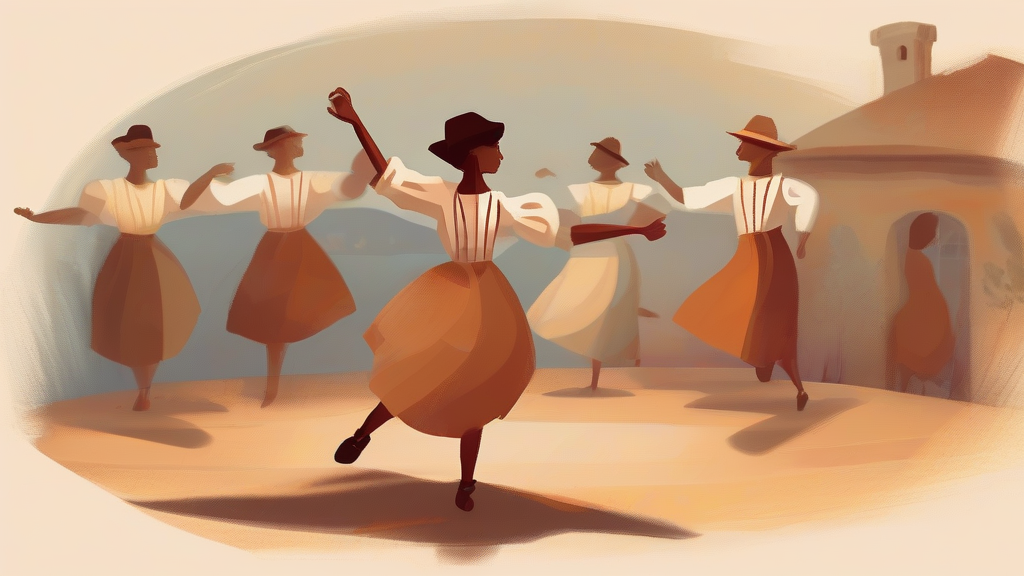
What does farandole mean?
The farandole is a traditional chain dance originating in Provence, in southern France, in which any number of dancers join hands or link handkerchiefs to form a long, winding line. Led by a front couple or by musicians playing pipes and drums, the line snakes through village streets in figures that can spiral, arch, or knot together, making it a centerpiece of Provençal festivals and celebrations. The word also refers to the brisk music that accompanies the dance, and composers such as Bizet — whose Farandole from L'Arlésienne is widely performed — have brought it into the concert hall. Derived from French via Provençal, the term evokes communal joy and Mediterranean folk tradition. Though rarely used outside discussions of dance, folklore, or music, it offers writers an exact and colorful word for this distinctive spectacle of collective movement.
nounA lively Provençal chain dance in which dancers hold hands or link hands with handkerchiefs and snake in a long line through the streets, traditionally led by musicians; also the music written for such a dance.
- A lively Provençal chain dance performed by dancers holding hands or handkerchiefs in a long snaking line.
- A piece of music composed to accompany this dance, typically in quick duple time.
"At the festival in Arles, villagers joined hands for the traditional farandole through the town square."
"The wedding guests formed a farandole that wound its way from the church steps down to the harbor."
"Bizet's Farandole from L'Arlésienne remains one of the most exhilarating pieces in the orchestral repertoire."
Standard pluralization; both senses (the dance and the piece of music) pluralize regularly.
"The program featured two farandoles, one arranged for full orchestra and one for wind band."
The farandole turns entire towns into a dance floor — a human serpent of linked hands snaking through Provençal streets at festivals like Les Saintes-Maries.
Reviewed by Deb Chak, Editor. AI-assisted content curated by RJS Tech Solutions LLP.
Etymology of farandole
The word entered English from French farandole, which itself comes from the Provençal farandoulo, the name of the traditional chain dance of southern France. Its deeper origins are uncertain; one frequently cited suggestion derives it from Spanish farándula, meaning a company of traveling performers, though this connection is not firmly established. The dance has been associated with Provençal folk life for centuries and became internationally familiar partly through Bizet's orchestral setting in his music for L'Arlésienne (1872).
How farandole is actually used
The word carries a distinctly French cultural flavor and is most often encountered in writing about Provence, folk traditions, or classical music. It is a literary or specialist term rather than everyday vocabulary.
Easily confused with farandole
A farandole is a chain dance from Provence, while a farthingale is a hooped structure worn under skirts to widen them in the sixteenth and seventeenth centuries.