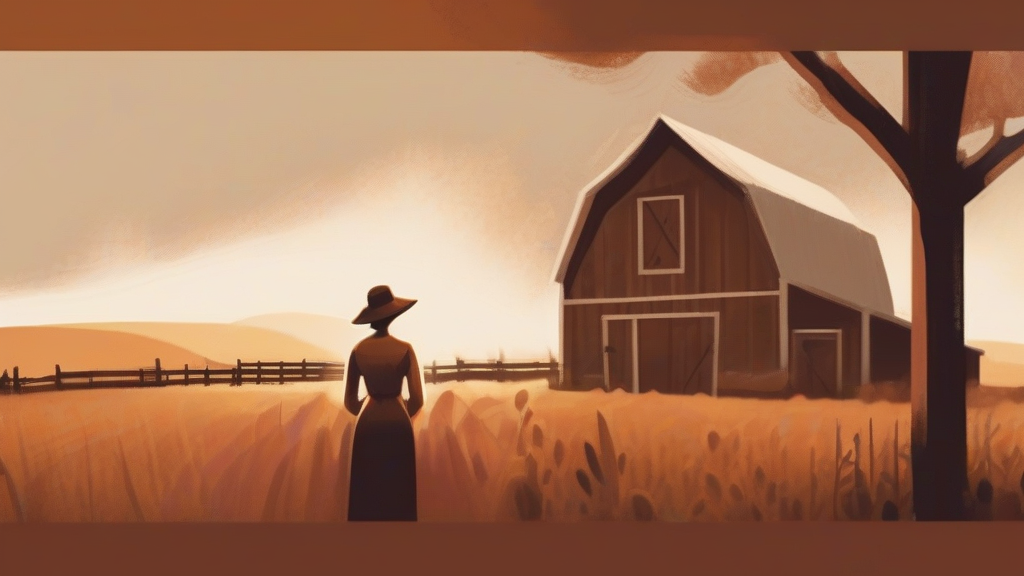
What does farmeress mean?
A farmeress is a woman who owns, manages, or labours on a farm — in short, a female farmer. The word was formed by attaching the feminine suffix '-ess' to 'farmer', following the same pattern that produced 'actress', 'lioness', and 'poetess'. It appears most often in the literature and records of the eighteenth and nineteenth centuries, when writers frequently used such gendered forms to mark women entering public and working life. Today it has largely fallen out of use: modern English treats 'farmer' as gender-neutral, and calling a woman a farmer requires no special form. Encountering 'farmeress' now usually signals a historical text, a deliberately archaic register, or an author evoking rural life in an earlier era. Though obsolete as everyday vocabulary, it remains a tidy example of how language both reflects and abandons the social distinctions of its time, making it a small but telling artifact in the history of English word formation.
nounA woman who owns, manages, or works a farm; a female farmer.
- A woman who farms; a female owner, manager, or worker of agricultural land.
"The farmeress rose before dawn to tend her flock."
"The widowed farmeress ran the dairy single-handedly for thirty years."
"In her novel, Hardy portrays a capable farmeress who commands the respect of every farmhand."
The plural adds '-es' because the base already ends in the syllable '-ess'; stress remains on the first syllable.
"The fair awarded prizes to several farmeresses from the surrounding valleys."
Farmeress belongs to a family of '-ess' words — like authoress and poetess — that once marked women's achievements, then faded as those professions simply became 'farmer'.
Reviewed by Deb Chak, Editor. AI-assisted content curated by RJS Tech Solutions LLP.
Etymology of farmeress
Farmeress derives from 'farmer', which entered Middle English via Old French 'fermier', ultimately from Medieval Latin 'firmarius', meaning one who holds land at a fixed rent ('firmus'). The suffix '-ess', borrowed from Old French, was widely applied from the medieval period onward to form feminine counterparts of agent nouns. The compound thus follows a well-established English pattern, though its use peaked in later centuries and has since been displaced by the neutral 'farmer'.
How farmeress is actually used
Farmeress is now rare and largely historical, belonging chiefly to 18th- and 19th-century literature. Modern usage strongly prefers 'farmer' for all genders, so employing 'farmeress' today is generally deliberate — evoking period flavor, literary style, or historical context.
Easily confused with farmeress
Farmer is the standard gender-neutral term for anyone who runs or works a farm, whereas farmeress is an obsolete feminine form that survives only in older or literary usage.