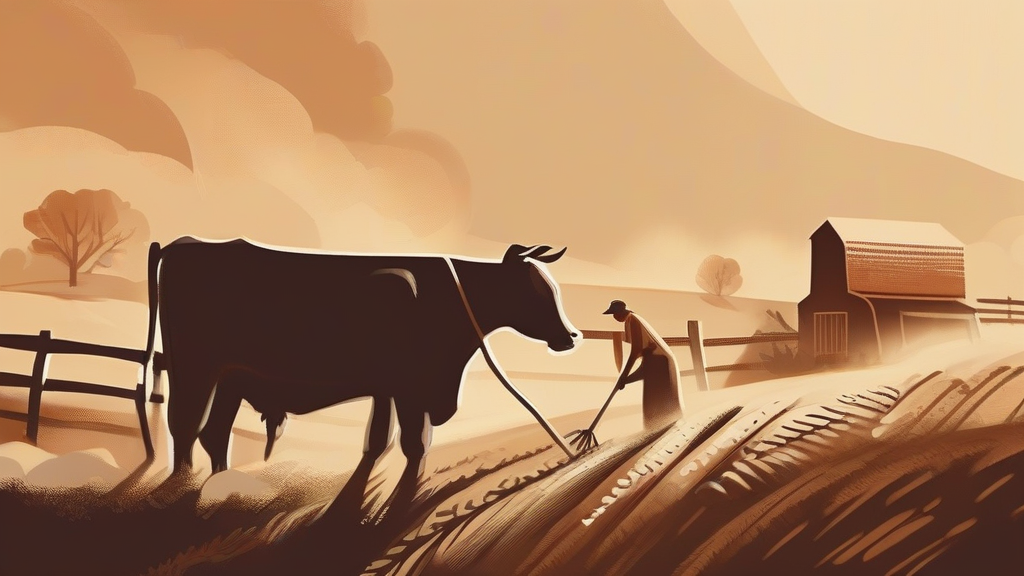
What does farmer mean?
A farmer is a person who owns, manages, or works a farm, growing crops or raising animals for food, fibre, or fuel. The word applies across scales of agriculture — from smallholder subsistence farmers who feed their own families to large-scale commercial operators running thousands of acres — and appears in fixed phrases such as 'dairy farmer', 'tenant farmer', and 'farmer's market'. Farmers occupy a distinctive place in cultural imagination: often romanticised as stewards of the land, yet frequently discussed in economic terms of subsidies, yields, and market pressures. The word derives from Middle English 'ferme', borrowed from Old French, which itself came from Latin 'firmus' meaning fixed or firm — reflecting an original sense of paying a fixed sum for land or revenue rights. Today 'farmer' remains one of humanity's oldest continuous professions, essential to food supply worldwide.
nounA person who owns or manages a farm, cultivating land or raising livestock for food or other products.
- A person who owns or manages a farm, cultivating crops or raising livestock.
- (Historical) A person to whom the collection of taxes was farmed out for a fee.
"The farmer rose before dawn to milk the cows and check on the newborn lambs."
"The farmer loaded crates of fresh tomatoes onto his truck bound for the weekend market."
"As a tenant farmer, she paid rent on the land but kept the bulk of each harvest."
Regular plural; used both generically ('Farmers work long hours') and specifically ('Several farmers attended').
"Local farmers brought their produce to the city market every Saturday morning."
The word 'farmer' originally meant someone who paid a fixed rent — a 'firm' — for the right to collect taxes or profits, before it ever meant someone who worked the soil.
Reviewed by Deb Chak, Editor. AI-assisted content curated by RJS Tech Solutions LLP.
Etymology of farmer
Farmer comes from Middle English 'fermere', derived from Old French 'fermier' and ultimately from Medieval Latin 'firmarius', meaning one who holds land at a fixed rent ('firmus', firm). Its earliest English senses concerned leasing or contracting — including collecting taxes at a fixed price — before narrowing by around the sixteenth century to mean one who cultivates leased or owned agricultural land. Cognates include modern French 'fermier' and related forms in other Romance languages.
Related word forms
How farmer is actually used
In everyday use, 'farmer' is neutral and widely understood across English-speaking regions. In British English it can carry connotations of rural tradition and class (e.g. the landed farmer versus tenant farmers), while in American usage it is more straightforwardly occupational. The historical sense relating to tax collection is now largely obsolete.
Easily confused with farmer
'Farmer' is a person who cultivates land, while 'pharma' refers to the pharmaceutical industry; the two merely share similar sounds.