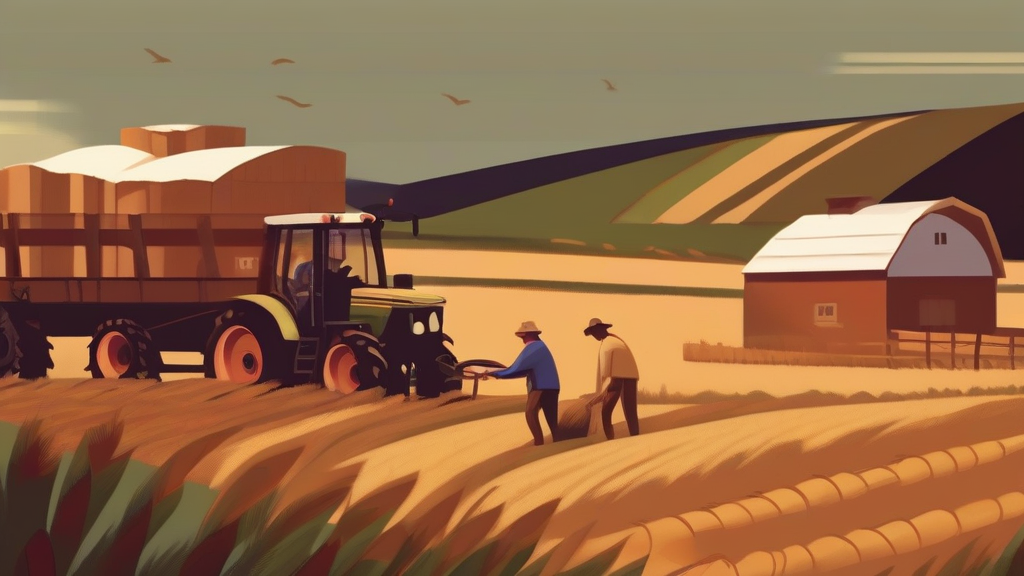
What does farmwork mean?
Farmwork refers to the labor performed on a farm, encompassing tasks such as ploughing, sowing, harvesting crops, feeding and tending livestock, repairing fences, and maintaining machinery. It is an uncountable noun used in both everyday speech and more formal writing about agriculture and rural life. The word carries a connotation of physical, often seasonal effort, and it features prominently in discussions of rural economies, migrant labor, and food production. Speakers commonly pair it with modifiers like 'seasonal' or 'hard' to convey its demanding nature. Though simple in form, combining the ancient English words 'farm' and 'work', farmwork remains a vital vocabulary item because agriculture continues to shape economies, immigration policy, and debates about sustainable food systems. It is useful for anyone describing rural employment, personal experience of country life, or the human effort behind the food supply chain.
nounWork done on a farm, especially the manual labor involved in cultivating crops or raising livestock.
- The physical and managerial labor carried out on a farm, including planting, harvesting, tending animals, and maintaining equipment and buildings.
"After university she spent a summer doing farmwork in the valleys of rural Andalusia."
"He grew up doing farmwork before and after school, milking cows and mending fences."
"The region's economy depends heavily on seasonal farmwork, drawing thousands of migrant laborers each autumn."
Rarely if ever pluralized; treat farmwork as an uncountable noun and express quantity through phrasing such as 'pieces of farmwork' or by naming specific tasks.
"Much of the farmwork is done by hand during the harvest."
Despite being centuries old at heart, 'farmwork' is so practical a term that modern immigration debates and harvest statistics still hinge on it today.
Reviewed by Deb Chak, Editor. AI-assisted content curated by RJS Tech Solutions LLP.
Etymology of farmwork
Farmwork is a compound of two Old English elements: 'farm', which originally denoted a fixed payment or lease of provisions before evolving to mean land held under such a tenancy and eventually the cultivated property itself, and 'work', from the Old English 'weorc', meaning labor or deed. The compound arose naturally in English as agriculture became central to rural society, describing the practical labor that farms required. Its components are thoroughly Germanic, and it shares its roots with related formations such as farmer, farmland, and farmyard.
How farmwork is actually used
Farmwork is typically treated as an uncountable noun and takes no plural in ordinary use. It carries a neutral to slightly rustic register, appearing frequently in agricultural policy, sociology, and discussions of migrant labor, where terms like 'farm labor' or 'agricultural work' may substitute in more formal contexts.
Easily confused with farmwork
Formwork is the temporary moulding into which concrete is poured on construction sites, while farmwork is labor performed on a farm.