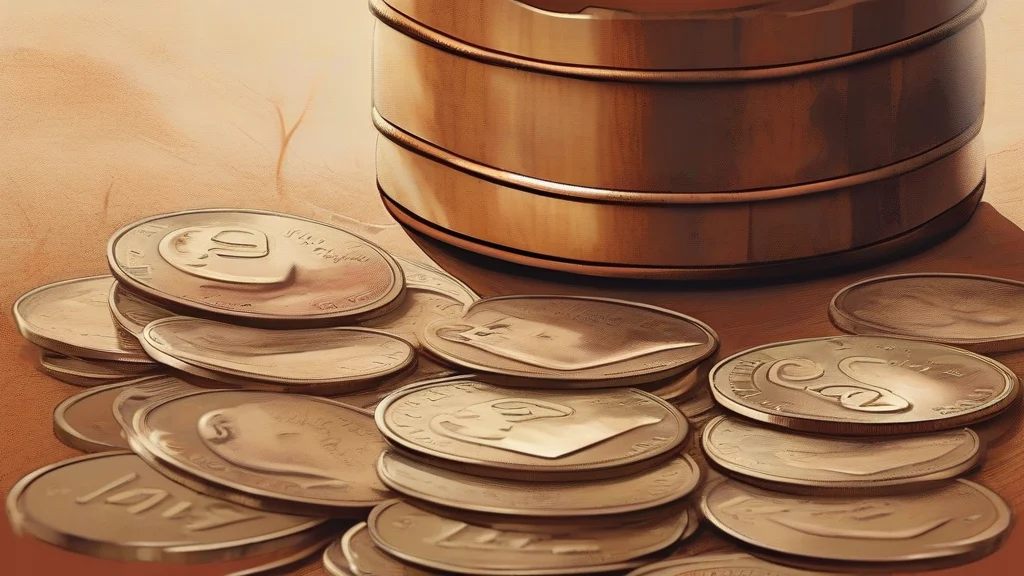
What does farthing mean?
A farthing was the smallest denomination of British currency, equal to one quarter of a pre-decimal penny. Minted for centuries, it circulated as a small copper or bronze coin until 1960, when it was withdrawn shortly before Britain's move to decimal currency. The name comes from Old English 'fēorthing', meaning 'a fourth part', reflecting its value as a quarter of a penny. Though no longer legal tender, 'farthing' endures in historical writing and in idiomatic expressions such as 'not worth a farthing', which describes something of little or no value. For modern readers, encountering the word usually signals either a historical setting or a deliberately archaic turn of phrase, and understanding it offers a window into a monetary system where even the humblest coin carried a name rooted in fractions.
nounA former British coin worth one quarter of a penny, withdrawn from circulation in 1960; the smallest unit of pre-decimal English currency.
- A former British bronze coin worth one quarter of a (pre-decimal) penny, abolished in 1960.
- A token or amount of negligible value, as in 'not worth a farthing'.
"The old ledger recorded every farthing spent on candles and coal."
"He counted out every last farthing he owed the shopkeeper."
"Her testimony wasn't worth a farthing to the skeptical magistrate."
Standard pluralization; used both for multiple coins and in figurative expressions about sums of money.
"She saved her farthings in an old tin box under the bed."
Britain's tiniest coin was so worthless by 1960 that when it was finally withdrawn, the Queen had to approve an Act of Parliament just to retire it.
Reviewed by Deb Chak, Editor. AI-assisted content curated by RJS Tech Solutions LLP.
Etymology of farthing
Farthing derives from Old English 'fēorthing', meaning 'a fourth part', formed from 'fēortha' ('fourth') with a diminutive suffix. The term reflects the coin's value as a quarter of a penny and shows influence from Old Norse 'fjórðungr', meaning a quarter. It shares its ultimate root with other words descended from the Indo-European word for 'four', such as 'four', 'fourth', and 'quarter'.
Related word forms
How farthing is actually used
Archaic and historical today; the word survives mainly in literature set before decimalisation and in fixed phrases such as 'not worth a farthing', where it conveys utter worthlessness.
Easily confused with farthing
'Furthering' is the act of helping something advance, while 'farthing' is a small former British coin.
A 'farthingale' is a hooped petticoat worn in the sixteenth and seventeenth centuries, unrelated in meaning to the coin despite the similar spelling.