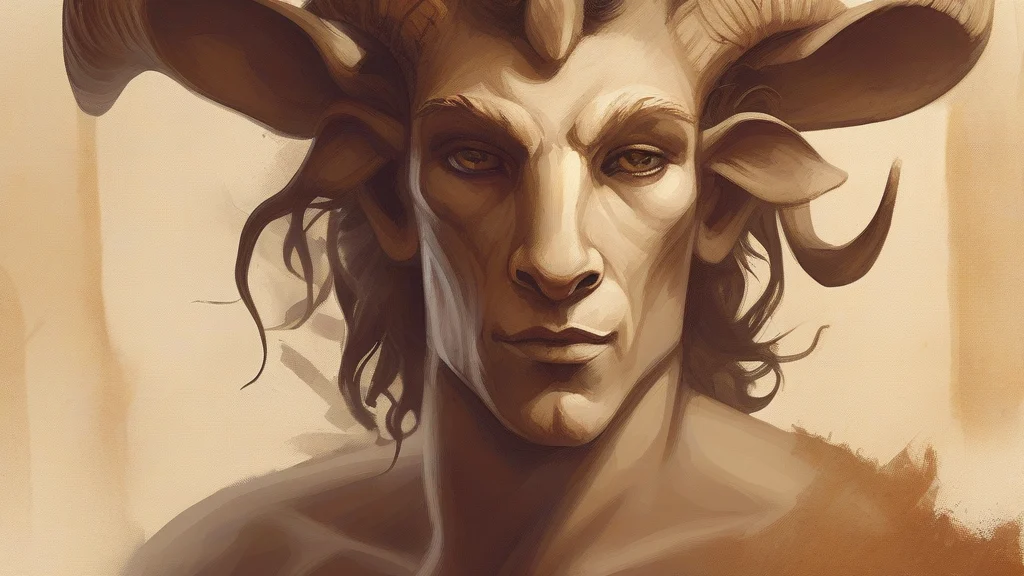
What does faun mean?
A faun is a nature deity of ancient Roman religion, imagined as a rustic figure combining human features above the waist with the horns, ears, tail, and legs of a goat. Fauns were associated with wild and cultivated countryside alike — woodlands, glens, flocks, and fertility — and were believed to haunt remote places while playing music on pipes. The word derives from Faunus, the Roman god of fields and shepherds, and was adopted into English in the early seventeenth century. Over time, the faun became largely interchangeable with the satyr of Greek myth, though the two were originally distinct. Today the word appears chiefly in discussions of classical art, Renaissance and modern painting, poetry, and fantasy fiction — most famously in C.S. Lewis's Chronicles of Narnia, where the faun Mr Tumnus introduces readers to Narnia. Its enduring appeal lies in its embodiment of humanity's kinship with, and unease before, the wild natural world.
nounA faun is a rural deity of ancient Roman mythology, depicted as a man with the legs, horns, and sometimes ears of a goat. In modern usage, the word refers to any similar creature of art or literature resembling this figure.
- One of the ancient Roman rural deities, part human and part goat, associated with woodlands, flocks, and fertility.
- Any figure in art, literature, or popular culture modelled on this mythological creature.
"In the painting, a playful faun frolicked among the vines, piping on a reed flute."
"The marble statue of a faun, its goat legs mid-leap, dominated the museum's Roman gallery."
"Panicked by his own shadow, the shepherd swore he had glimpsed a faun dancing at the forest's edge."
The standard plural is simply 'fauns'; there is no irregular plural.
"The garden's statuary included a row of fauns peering out from beneath the hedges."
C.S. Lewis opened the gates of Narnia with a faun named Mr Tumnus — carrying an umbrella and parcels through a snowy wood.
Reviewed by Deb Chak, Editor. AI-assisted content curated by RJS Tech Solutions LLP.
Etymology of faun
The word faun comes from Latin 'Faunus', the name of the ancient Roman god of fields, shepherds, and prophecy, whose cult dates back to Rome's earliest history. The Latin term entered English in the early seventeenth century, when interest in classical antiquity was flourishing. Because Faunus was increasingly identified with the Greek god Pan, the faun came to be depicted with goat characteristics and to merge with the satyr of Greek mythology. A notable cognate is 'fauna', coined from the same root as a collective term for animal life.
Related word forms
How faun is actually used
Faun is almost exclusively encountered in contexts concerning classical mythology, art history, or fantasy literature. It carries a literary, slightly archaic flavour and no negative connotation; it should not be confused with the everyday word 'fawn'.
Easily confused with faun
Satyrs are Greek woodland deities often conflated with fauns, but in classical Greek art satyrs appeared more human and horse-like, while fauns are Roman goat-like figures; later tradition largely merged the two.
A fawn is a young deer (or a pale yellow-brown colour), whereas a faun is the mythological goat-man; the two differ by one letter but have unrelated meanings.