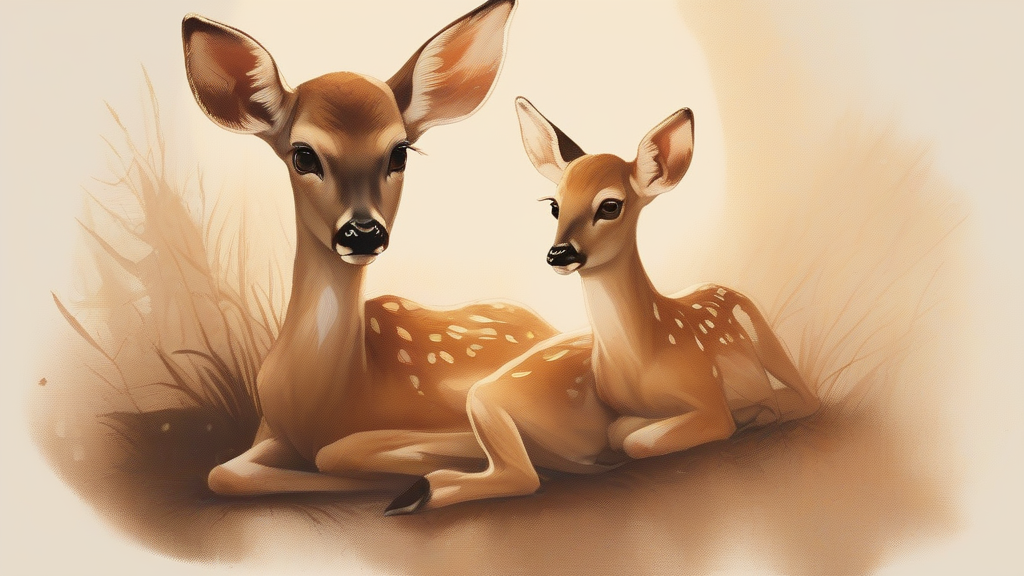
What does fawn mean?
A fawn is a young deer, especially one in its first months of life, distinguished by a soft coat dappled with white spots that helps it blend into sunlit undergrowth. By extension, 'fawn' also names the pale yellowish-brown colour of that coat, a shade long favoured in clothing, leather goods, and interior design. The word carries a second life as a verb: to fawn over someone is to shower them with excessive, often insincere praise or attention in hopes of winning favour. This verbal use is almost invariably unflattering, conjuring images of sycophants circling a powerful patron, which makes it a pointed choice in political and workplace commentary. The noun and verb have separate origins — the deer from Latin roots carried through French, the verb from an old Germanic word for being glad — yet both converge on the idea of eager, sometimes helpless devotion, giving this small word unusual range across nature, art, and human behaviour.
A young deer, especially one in its first year, still bearing a spotted coat; also, a pale yellowish-brown colour resembling such a coat.
"She painted the nursery walls a soft fawn that glowed warmly in morning light."
The colour sense is common in fashion, textiles, and interior design.
To behave in an excessively affectionate or servile manner toward someone, typically through flattery intended to secure favour.
"He despised colleagues who fawned over the chairman at every meeting."
Almost always derogatory; most frequently used with the prepositions 'over' and 'upon'.
Regular plural; used when referring to multiple young deer or multiple shades of the colour.
"By late spring, the meadow was dotted with fawns following their mothers."
The word 'fawn' has two completely unrelated histories: the baby deer trotted into English from Latin via French, while the flattering verb grew out of an Old English word simply meaning 'glad' — so a courtier fawning over a king was originally just being happy about it.
Reviewed by Deb Chak, Editor. AI-assisted content curated by RJS Tech Solutions LLP.
Etymology of fawn
The noun 'fawn', meaning a young deer, came into English through Old French 'faon' (originally denoting any young animal), ultimately deriving from Latin terms connected to offspring and suckling, a root it shares with words such as 'foetal' and 'fecund'. The verb 'fawn' has an entirely independent origin in Old English 'fægnian', meaning to rejoice or show delight, formed on an adjective meaning 'glad' whose cognates survive in other Germanic languages; over time, showing joy at a superior's presence hardened into servile flattery. The two strands met only coincidentally in modern English spelling.
Related word forms
How fawn is actually used
As a noun, 'fawn' is neutral and descriptive, used both in wildlife contexts and in fashion and design for the colour. As a verb, it is almost always pejorative, implying insincerity or servility; the phrasal pattern 'fawn over' is by far the most common construction today.
Easily confused with fawn
A 'faun' is a mythological Roman deity of the countryside, half-man and half-goat, whereas a 'fawn' is a real young deer (or the flattery verb and its pale brown colour).